Showing posts with label tolerance. Show all posts

Sunday, 12 September 2010

Children's Literature and 'Otherness'

In his influential book 'Exclusion and Embrace', theologian Miroslav Volf shows that understanding and living with the 'Other' - that is one unlike ourselves - is not simply a matter of accommodating diversity. He suggests that our approach to the 'other should reflect the character and actions of our God revealed in the person of Christ. Volf challenges us to embrace ‘the other’ in the light of God’s giving of himself on the cross—this includes our enemies. We need to adjust our very identities to ‘make space’ for the other. This is a challenge for all people. 

Australia like many Western democracies has experienced a diversification of immigrants coming to our shores in the last few decades. Almost all of us are immigrants in this country, with the exception of Indigenous Australians who make up about 3% of the population. With each new wave of immigration there have been tensions as fear of the impact of new residents has led some to question immigration levels (see my previous post on 'Dispelling the Myths of Boat People').

Volf's work is a counter to other responses to increasing population diversity and struggles to deal with difference. While some see the celebration of multiculturalism as solution enough to a fear of others, such views are simplistic. While multiculturalism has the potential to encourage the recognition of different cultures and the valuing of all people in spite of difference, there is a danger that while celebrating diversity in cultural practices, we may simply mask deep-seated fears and prejudices. In other words, we might be happy and comfortable with others as long as we can see ourselves in them. At the base of opposition to immigration is often a fear of what we don't know about other people. Can literature help to break down such fears?
 
Embracing the 'other' through literature


Literature can be a great help in developing tolerance and in breaking down fear of the other, but like multiculturalism it can also gloss over differences. As continental philosopher Emmanuel Levinas argued, Western tradition has tended to privilege the 'same' over the 'other', acknowledging the 'other' only to the extent that they can be 'made' to be like us. While it is easy to see this tendency in the colonial domination of nations and people, Levinas argues that we are slower to recognize it in our individual actions and thinking towards others, resisting (or quietly ignoring) difference and embracing that which we recognize in ourselves.

If authors fall into this trap their work will do little to reduce the fear of the other; rather, it might simply smudge out the inconvenient differences, such as religious beliefs, while underlining that which is common in our shared humanity. This might lead to little more than a shallow acceptance of others that is tested when our world is impacted even in small ways.

In the educational field multicultural literature programs have been seen as a valuable way to fight racism. But while literature has the potential to hold a light to what is common and different, it can also represent an ideological quest to remove that which has been judged to be wrong and oppressive because it is different. For example, much post colonial literature in seeking to legitimately offer new voices from previously unheard groups, can easily villianize previously dominant views of the world. Christianity has received much blame for such oppression, as have white males. This is not to ignore the fact that both groups have been responsible for wrongs, but if literature is to offer a critique or counter to racism and fear, then it must do more than blame others; it must encourage us to consider, listen to and understand others.

With the above in mind we need to view any piece of literature that deliberately sets out to offer an alternative reading of our times with healthy analysis. There is an even greater need to adopt a questioning stance when the literature has been written for children.  A recent example is worthy of consideration.
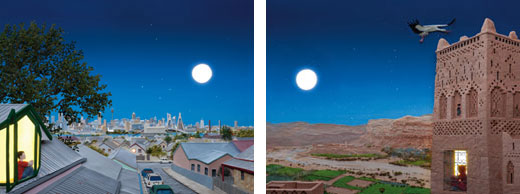

'Mirror' (2010) by Jeannie Baker

Jeannie Baker is an English artist who has lived in Australia for over 30 years. She is well known for her outstanding collage art that she frequently turns into children's picture books. You can read a review of her work on my blog 'Literacy, Families & Learning' (here). Her books usually have few or no words and typically offer some form of social commentary. She has written in particular about the impact of humanity on the natural environment.  But her latest work 'Mirror' is an attempt to challenge her readers to consider two families in two places - one in Sydney and one in Morocco. One we assume to be Christian and the other Muslim.

The concept for the book is brilliant, the quality of the images stunning, and the book design groundbreaking. The wordless picture book that she has created is, as usual, challenging at many levels. It is the concept and design that will first catch your attention. The book is slightly more square in shape, and it defies your efforts to open it in a conventional way. This picture book comprises two stories that are designed to be read simultaneously – one from the left, the other from the right (see below). As you pick up the book you try to open it from right to left only to have the book open at the middle to reveal two books, one that is read from left to right and begins in Arabic, and the other from right to left that begins with English. Page by page, we experience a day in the lives of two boys and their families - one from inner city Sydney, Australia and the other from a small, remote village in Morocco, North Africa.


Jeannie Baker conceived the book while travelling alone in Morocco. It was while immersed in the warmth and generosity of the Moroccan people and while experiencing the sights, smells, sounds and textures of the place, that she conceived the idea and knew she had to produce it even without approval from a publisher. Baker's book, in a sense, holds a 'mirror' to the world and produces a stunning and memorable insight into two families in two quite different places.

While the two worlds portrayed couldn’t be further apart, she shows through the parallel lives of the two families, a simple and profound truth. While people live in vastly different places, and have different lives, we share much. There is much that is different about the families. The book itself shows that language is different and how it is accessed is different. The illustrations and story show that religion, homes, landscape, transport, clothing, food, shopping, market places, daily tasks and family practices are different.  But there is also much that is the same. Family members love one another and depend on each other. A mother and father work each day and children learn, help at home and spend time with family. Children in Morocco do different things each day than in Sydney, but they are perhaps more like us than we might imagine. And there is an additional truth - we are connected to each other. With subtle use of images Jeannie Baker is able to show this connection. The delight of the reader is to discover these, with technology and trade as two examples. My grandson shouted excitedly as we read the book together for the first time "Look, look, it's the same carpet. The carpet they were making (in Morocco) is the same carpet they bought (the people in Sydney)".

How successful is Baker at communicating common humanity while not glossing over difference? Quite successful I think. While there are limits to what can be communicated with a wordless picture book, she offers a piece of literature that does more than offer a tokenistic view of common ground across two families and two different cultures.  This is a book that notes the differences while at the same time recognizing that we share humanity. Her book should be a challenge to Christians and non-Christians to be open to the embrace of the other. At the very least, books like this one offer a wonderful tool for conversations with our children about other people with different faiths and cultural practices.  For the Christian parent, the hope is that these conversations will lead our children to reflect the character and actions of our God revealed in the person of Christ. Our hope should be that they grow up to embrace the 'other’ in light of God’s mercy and grace in giving himself on the cross. Our hope should be that as they grow they would develop identities that meet Volf's challenge to ‘make space’ for the other and in doing so to offer paths for the sharing of their faith in Christ with humility, grace and love.

In a recent edition of Case magazine on 'Otherness' Mattheson Russell offered this sound advice:

"...the problem of otherness is no dry and abstract matter. It is a problem that is intimately bound up with fundamental questions we all face in the contemporary world: Is there anything more to life than acquisition, competition and violence? Dare we believe that it is possible to live with others - avowed and disavowed others - in communities of peace? Dare we believe that at the heart of the universe is an Other who is love?"

Literature is one simple vehicle that can be used by God to chip away our collective and individual fears and prejudices. As we learn about others and lead lives centred on Christ, we can be used by God to point 'others' to him.

Other posts

'To Exclude or Embrace: Considering Otherness' (HERE)

'Author Focus: Jeannie Baker' (HERE)

Thursday, 6 March 2008

The intolerance of tolerance

When Phillip Jensen gave his inaugural sermon as Dean of St Andrews Cathedral (Sydney) in March 2003 his sermon was big news in the media the next day. Why? Because he suggested that religious beliefs can be right or wrong. In this post, my third in a series on worldview, I want to discuss relativism and its relationship to tolerance.


I was at the Cathedral when Phillip Jensen spoke and can attest that he spoke respectfully of other religions. The issue that caused most media response was that he suggested that if two religious belief systems make incompatible truth claims that at least one (or both) could be wrong, but he suggested that they couldn’t both be right. For example, if Islam says Jesus was a great man and prophet and Christianity claims that Jesus was and is the Son of God who rose from the dead, then either both views are wrong or one is wrong. Both can’t be right.

Phillip Jensen went on to say that to allow people of different beliefs to practice them in harmony without coercion or persecution is tolerance. But to deny that such differences exist or to assume that all views are right is “irrational relativism”.

Relativism is a philosophical “theory of knowledge or ethics which holds that the criteria of judgement are relative, varying with the individual, time and circumstance” (Macquarie Dictionary). In Simon Smart’s book A spectator’s guide to worldviews: Ten ways of understanding life (see my previous review of the book and my post on Liberalism), John Dickson provides a useful introduction to Relativism. He points out that as an increasingly dominant worldview over the last 250 years, it has had a significant impact on a range of human experiences, including morality, culture, religion, philosophy, science and the idea of human existence. Its origins are traced primarily to thinkers of the Enlightenment like Hume, Kant, Rousseau and others, but can be traced right back to a Greek philosopher named Protagoras (490-421 BC) who also developed the doctrines of Orthoepeia, the study of the correct use of words, and Agnosticism, the claim that we cannot know anything about the gods.


The views of Protagoras weren’t well received at first. Plato provided a strong critique of his work, particularly the idea that “man is the measure of all things”. He suggested that if everything is relative to man’s own perspective, then that must apply to Protagoras’s own view that truth is relative. That is, his view is just one view among many. But Plato went further, because if Protagoras did believe that truth was only true according to one’s perspective, then his idea must be false, because he had conceded that at least one truth (Protagora’s truth) would not be relative. Most accepted Plato’s argument and largely ignored relativism for over 2,000 years.

But by the 17th to 18th centuries philosophers like Immanuel Kant (1724-1804) began to argue that the true nature of reality was beyond our human senses. The deeper things of life like God and morality are inaccessible to our senses. While Kant wasn’t a relativist, his theory led many who did not believe in God to argue that only the things you can observe in the natural world can be claimed to be objectively real. All the rest was seen as subjective speculation.

It didn’t take long for other philosophers (e.g. Friedrich Nietzsche, 1844-1900) to argue that the ‘truths’ of spirituality, ethics and culture, were simply relative truths – true only within the framework of the society in which they believed.

When the stories began to appear about Phillip Jensen’s first sermon at the Cathedral one view probably summed up where most of his opponents sat. The Sydney Morning Herald reporter Chris McGillion penned these words:

"To say that my religion is the one true religion can only ever be a claim based on faith. It can’t be proved or disproved because there are no criteria by which to test the claim apart from propositions that are internal to the thing being claimed in the first place."

McGillion went on to suggest that we should never confuse religious truth with knowledge. It is faith, not knowledge. He was suggesting that truth claims about God cannot be debated in normal terms. You have to hold a specific faith position that is not the same as knowledge.

As Tony Payne suggested in an insightful Briefing article on the media response to Phillip Jensen’s sermon (Briefing, 296, May 2003), McGillion had bought the post enlightenment view that truth is relative and that matters of faith and matters of knowledge are separate. That is, one’s faith, and the worldview that might be shaped by it CANNOT inform and have relevance to one’s physical world. This view assumes that what one believes about God CANNOT give meaning and value to the way we view and interpret the world of nature.

But as Tony Payne points out, Christians have at the very centre of their truth claims that God himself acted in human history in the person of his Son (Jesus Christ). Christianity asserts that Jesus lived, died and rose from the dead as a matter of history. This is contrary to enlightenment philosophers' claims (and 21st century journalists) that Christian truth claims cannot be tested at the point where they interact with human history.

To this Payne adds an additional criterion by which religious claims can be tested – their intersection with reality – the reality of lived human experience. If religions assert things to be true about the world (about life and people), these claims can be assessed as to their general accuracy.

In Dickson’s discussion of relativism he suggests that perhaps the most attractive thing about relativism is the seeming close connection it has with tolerance. If we insist that moral, cultural and religious ‘truths’ are simply relative (no-one is right or wrong), then this is likely to inspire tolerance towards the views of others. But “true tolerance does not involve accepting every viewpoint as true and valid; it involves treating with love and humility someone whose opinions you believe to be untrue and invalid….tolerance is the noble ability to treat with grace those with whom you disagree” (p.184).

This longing for tolerance is one that Christians share, and it is certainly part of the Christian foundations of New College and the reasons for the formation of CASE. It is a Centre that attempts to apply Christian understanding to all of life and asserts that matters of faith and matters of knowledge are NOT separate. That one’s faith, and the worldview that might be shaped by it CAN inform and have relevance to one’s physical world. What one believes about God CAN give meaning and value to the way we view and interpret the world in general. Was Phillip Jensen right in asserting that some religious views are right and wrong? Of course! Was he being intolerant? No! True tolerance is not accepting that all views are equal but accepting the right of all to express different views that are received with respect and hopefully informed response. Anything less than this is mere relativism.

Of course, there is a postscript that needs to be added to this, particularly for people who hold a particular faith position. The understanding that truth is not relative will raise tough issues within communities like the Christian church, for the Bible not only teaches that it is the truth, it also teaches that within the church of God this truth must be protected and that to allow relativistic thinking to permeate the church will have disastrous consequences. In Jesus’ revelations to the Apostle John he speaks to the seven churches of their strengths and weaknesses. To the Churches in Pergamum (Revelation 2:12-17) and Thyatira (Revelation 2:18-29) he warns of the consequences of allowing false teaching to enter into the church of God. We must never use the idea of tolerance as an excuse not to address error within the church. Christians might want to listen to a recent message (download MP3 here) from John Smuts at Petersham Baptist Church in Sydney on this theme.