Showing posts with label culture. Show all posts

Saturday, 25 June 2011

'To Change the World': A Review

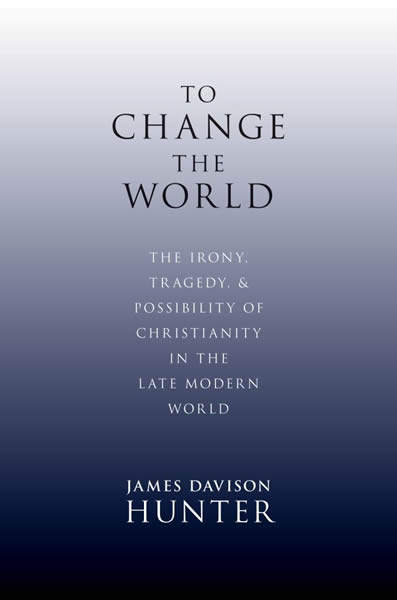
I've been reading James Davison Hunter's book 'To Change the World: The Irony, & Possibility of Christianity in the Late Modern World'. Many have acclaimed this book as one of the most significant Christian books for some time, including Tim Keller, Charles Taylor, Nicholas Wolterstorff and Justin Taylor. Justin Taylor says of the book:

Written with keen insight, deep faith, and profound historical grasp, 'To Change the World' will forever change the way Christians view and talk about their role in the modern world.

Has this book been over-hyped? Maybe a little, but it is a very significant book that has challenged my thinking about Christian engagement with the world.

The book has three parts, which Hunter calls 'essays', each with multiple chapters:
  • Christianity and World Changing
  • Rethinking Power
  • Toward a New City Commons: Reflections on a Theology of Faithful Presence
Hunter's aim in writing the book is to challenge Christians to think about the way they engage with culture and how they seek to change the world. He writes:
"I contend that the dominant ways of thinking about culture and cultural change are flawed, for they are based upon both specious social science and problematic theology. In brief, the model upon which various strategies are based not only does not work, but it cannot work."

Hunter begins in his first essay by offering a critique of the assumptions that have driven Christian public engagement and action. He looks first at culture and methodically demonstrates the errors inherent in how people view culture. Speaking from the vantage point of his life in America, he is critical of the political theologies of the Christian Right and Left and the Neo-Anabaptists in the USA.  He argues that if we want to change the world we "must begin with an understanding of what is to be changed."

The essence of culture he suggests is not found simply in the 'hearts and minds of individuals', that is, in what are called 'values'. Efforts to change values, worldviews and impart great ideas of what is real and true, will fail to change the world. Wilberforce, Churchill, Martin Luther King, Mandela and others did not change the world because they simply held to the right values.  Our views of culture, are in his view weak, and fail to take into account the factors that give it strength and resilience over time. Change does not occur simply through the power of great ideas, but as these ideas meet elite networks and institutions, penetrate them and then spread their influence through new institutions and networks of influence.  He argues that at every point of significant cultural change there is "rich patronage" that resources intellectuals and educators who within their networks "..imagine, theorize and propagate an alternative culture." Overlapping networks of leaders and resources come together and give a critical mass to the ideals, practices and goods of an alternative culture.   

Hunter is at pains to stress that while he believes evangelism and social reform are priorities for the church, the working theory of culture on which they are based is flawed. In a sense he is saying that churches and individuals pursue right agendas to make Christ known in word and deed, but they are doing this often from a position of isolation on the periphery. His stress on networks and in particular the penetration of elite networks, would seem timely to me as I observe many Christians fleeing the professions, schools and universities to train for full-time ministry. Significant cultural change requires some Christians to be operating at the centre of elite networks.

Hunter also helpfully reminds us that at key moments in history new institutions are created that give form to culture, enact it and give expression to it. Hunter cites many examples of how his alternative hypothesis has been demonstrated at key points in history, including the spread of Christianity across the Roman Empire, the conversion of Barbarian Europe, the Reformation, the Great Awakening (1730s-1740s) and even many key periods of secular cultural transformation such as the Age of Enlightenment. How are Christians at work today to create and sustain such institutions? For example, if universities are one of the existing types of influential institutions, why don't more bright young Christian men and women commit to a lifetime of faithful work as servants of God within these networks?

An alternative, "Faithful Presence"

Hunter offers an alternative way for Christians to view how they should spend their lives for God. He suggests the embracing of a different paradigm to engage with the world, something he calls “faithful presence". This is an ideal of Christian practice that is both individual and institutional.

He begins to demonstrate what 'faithful presence' is by contrasting it with what it isn't; three 'paradigms of engagement' with culture and the world.  He suggests that there are three major paradigms at work today:

a) 'Defensive Against' - This is seen in the activities of political and cultural conservatives who join forces to create enclaves set against the world. Christians who embrace this paradigm have as their major objective the retention of Christian orthodoxies and conduct (e.g. lifestyle, ethics, liturgy, church practices etc). Christian institutions of all types he suggests are created to hold off the forces of pluralism, secularisation and change.

b) 'Relevance To' - For adherents to this paradigm the aim is to ensure relevance to the issues and problems of the age. While Hunter suggests that liberals were the first to embrace this paradigm, more recently some evangelicals have moved in the same direction. The 'seeker-church' and 'emerging church' movements are examples of this paradigm that place a priority on being connected to the issues of the day; being in touch and meeting the "felt-needs" of church attenders, especially non-believers.

c) 'Purity From' - This paradigm he argues is reflected in a desire to uphold historical truths (like 'Defensive Against'), but this group goes further and concludes that there is little to be done for the world in its fallen state. The central task then is to extricate itself from the forces of the world and enable authentic witness.

While not suggesting that each of these major paradigms is without biblical justification, or that all the activities that characterize these paradigms are without merit, Hunter argues that ultimately they fail to effect major cultural change and make a difference for the Kingdom of God. Using real-life examples and careful historical and cultural analysis, he suggests an alternative way based on what he calls the practice of “faithful presence.” Such practices will be more fruitful, Hunter argues, more exemplary, and more deeply transfiguring than any more overtly ambitious attempts can ever be. He reminds us that presence and place matter and that this is demonstrated so profoundly in the incarnation, "the very character of God and the heart of his Word is that God is fully and faithfully present to us." God pursues us, identifies with us, and offers us life through his sacrificial love. In short, a theology of presence is an engagement in and with the world around us. Hunter argues “...that where and to the extent that we are able, faithful presence commits us to do what we can to create conditions in the structures of social life we inhabit that are conducive to the flourishing of all.”

Responding to Hunter's Work

It would be easy to critique Hunter's work by pointing to the over-simplifications that can occur when allocating discrete categories that summarize complex and diverse expressions of Christian faith. But Hunter doesn't claim that his three paradigms neatly describe the world. It would also be easy to get to the end of his book and say, but what has he shared that helps the reader to practice faithful presence, for there is no 10 point checklist to follow. And we could also argue that too many Christians in the past have pursued the path of elite networks in the past for personal gain rather than the Kingdom of God. But I think his book should be a major corrective to how many of us think.

Hunter's book doesn't offer a simple explicit alternative. The reality is, as one reviewer observes, "Faithful presence is not the starting point of Hunter’s book, but its conclusion". The strength of Hunter's work is his methodical discussion of culture and our capacity to influence it, the evidence he presents in relation to the nature of cultural change and his critique of the way the Church deals with the challenges of pluralism and increasing secularisation.

The full benefit of Hunter's work will only occur as people read the work, discuss it with others and consider its implications for life. How do we spend our lives in the key relational communities that make up our world - family, church, neighbourhoods, workplaces, cities, nations? How do we relate to key institutions like the State? How do we fulfil faithful presence in the key roles we fill - husband, wife, son, neighbour, worker, boss, citizen? How do we see the significance of our influence within the spheres of our life - families, neighbourhoods, voluntary associations, work and so on. How does the way we live, in the places that we live, contribute to the flourishing of all? This is a book that deserves to be read by many and discussed at length.

Friday, 1 January 2010

The continuing quest for belief

One of the interesting things about Christmas is that as well as the regular token treatment that the media gives to Christmas Day church services; there is often an outbreak of 'wise' commentary on what is right and wrong with religion and Christianity in particular. The Sydney Morning Herald has had a variety of articles about Christianity and faith including two articles written by David Marr the Australian journalist, author, and political and social commentator. The Marr articles discuss a poll commissioned by the paper and conducted by the polling company Nielsen. It was a survey of 1,000 Australians concerning matters of faith. The results surprised many including (I think) Marr.

What the poll told us

In his first article in the Herald, Marr outlines the key findings as follows:
68% of people say they believe in God
53% of people say they believe life after death
56% of people say they believe in heaven
38% of people say they believe in hell
37% of people say they believe in the devil
51% of people day they believe in angels
22% of people say they believe in witches
41% of people say they believe in Astrology
49% of people say they believe in psychic powers like ESP
63% of people say they believe in miracles
34% of people say they believe that the Bible is the word of God
27% of people say that the Bible is literally true
42% of people say they believe in Evolution
84% of people support the separation of Church and State
David Marr's second article, "Politics and Religion: crossed paths" can be found here.

A diversified search for meaning

While Marr is not seeking to promote Christianity, he manages to put his finger on a number of salient points that I find interesting. While these findings suggest that the number of people who have faith in God has declined over the last century, they also suggest that many people still hold to some form of Christian faith. This is in stark contrast to church attendance. Rather than depressing those of us who still go to church, it should encourage us, as the results demonstrate that there is still much latent interest in God, even if this interest is confused by dabbling with astrology, psychic phenomena, superstition and so on. For many people, while there is some level of acceptance of God, they do not seek a relationship with God. Marr puts it this way:
"Belief for most Australians is about values far more than devotion. It's belief without belonging."
Marr concludes that while it is a minority of Australians that see the Bible as the word of God, Australian society can hardly be characterised as non-Christian, let alone atheistic. He suggests "Atheism is always about to break through and never does".

The survey results suggest that while some Australians have rejected mainstream Christian faith, they have not simply embraced atheism. In fact, many of those wandering from Christianity, seem to be drifting towards a variety of other religions and more minor belief systems. While they are rejecting God in the form that the Bible teaches, they are grasping for other beliefs that help them to make sense of their world.

One further interesting insight from the survey is the gendered nature of doubt and unbelief. It seems that men outnumber women 2 to 1 in denying the existence of God. As well, age seems to play a part, with 42% of people under the age of 25 years denying that there is a God, compared to only 25% of people over 55 years.

How do we respond to this?

This small survey reinforces what many Christians already know, that while many people reject mainstream Christianity, this does not mean they cease to be interested in matters of faith.

How do I reach out to people in their unbelief as well as to the many people searching after other forms of belief? There are clearly special challenges in reaching men and younger people in particular. How do we respond? We need to personalise this. Not what the Church needs to do, but what do I need to do? I'll give this a try.

For a start, I need to have a deeper desire to love those who don't follow Christ and to want to see them consider his claims in the Bible. I also need to pray for opportunities to share my faith and to invest in relationships with my neighbours, friends and family members. I need to deepen my own faith and to ensure that it translates into an authentic life, that is well lived; a life noticed for the right reasons, not the wrong ones. I also need to sharpen my understanding of the questions that non-Christians ask of me, and to respectfully listen to their claims and questions. I also need to be not only prepared to give a reason for my faith, but to seek opportunities to do so.

I need to do more than just offering a defence or reason for the hope that I have in Christ. As I wrote in an earlier post (here), I must do more than simply seeking to win arguments; my life must also commend Christ. David Hohne contributed an excellent essay to Case #20 in 2009 in which he used Peter’s challenge in his first letter (1 Peter 2:10-12) - to live 'beautiful lives' - as a framework for talking about apologetics. He argued that we are to have lives (not just words) that commend God to others.
“Keep your conduct among the Gentiles honourable, so that when they speak against you as evildoers, they may see your good deeds and glorify God on the day of visitation.”
David Hohne argued that our defence should not be simply rational argument; we must use our ‘head, heart and hands’ and live as apologetic people in apologetic communities - “…our whole lives [are to be] both a defence and commendation of the grace of God in Christ.” The church is not separate from culture, and yet it should stand out against it. I need to keep learning this lesson in 2010.

Related posts and articles

CASE has offered a variety of publications and blog posts in the last year or so that have attempted to help Christians think about the above questions. Here are a few:

'Apologetics is more than just winning arguments' (here)
'Humble Apologetics' (here)
'Apologetics in Family Life' (here)
'Apologetics of the Heart' (here)
'To Give a Reason' (The whole of Issue #20 of Case magazine was devoted to this topic)
'A New Epistemology' (here)
'The Need for truth, not seduction in a pluralistic society' (here)
'Being a church that welcomes children' (here)
'Loving Your Neighbour's Children' (here)
'The Reason for God' (here)

Sunday, 7 December 2008

Christ & Culture Revisited: A review

In 1951 H. Richard Niebuhr wrote the classic book, Christ and Culture. He set out to address the tricky matter of how Christians deal with culture, relate to culture and are positioned in relation to culture. He suggested that there are five main patterns when describing the relationship: Christ against Culture; Christ of Culture; Christ above Culture; Christ and Culture in Paradox; and Christ the Transformer of Culture. He outlined each in detail presenting their strengths and weaknesses and aiming to allow the reader to make up his or her mind about the option they felt made most sense.

For over 50 years Christians have looked to this book as a key guide to understanding the relationship between their faith and culture. In a recent book Don Carson has respectfully ‘revisited’ this work and offers a new perspective on Niebuhr’s now classic text. For those just returned from a 30-year trip to the outer edges of the Galaxy, Don Carson is Research Professor of New Testament at Trinity Evangelical Divinity School, Deerfield, Illinois. He is the author or co-author of many well-known books on theology.

Carson’s book, Christ and culture revisted was born out of discussions with his students at Trinity, a lecture series in Paris and his own theological reflections and study of the thorny problem of how any Christian sits in relation to his or her culture. Even in writing the last sentence it sounds as if I am positioning myself outside culture. The inability of any Christian to sit outside culture is something that Carson rightly points out is a serious challenge. To my mind this should lead us to admire and be thankful for the early and seminal work that Niebuhr did, while not denying that the work needs to be reconsidered.

A definition of culture

Before commencing his critique Carson begins by seeking a definition of culture. Finding an appropriate definition of culture is obviously critical to understanding where we fit in relation to culture. Carson dismisses ‘high culture’ definitions then considers a number of alternatives before settling (primarily) on Clifford Geertz’s definition as one that is workable:

“[T]he culture concept……denotes an historically transmitted pattern of meanings embodied in symbols, a system of inherited conceptions expressed in symbolic form by means of which men communicate, perpetuate, and develop their knowledge about and attitudes towards life.” [From Geertz, C. (1973), The interpretation of cultures, New York: Basic Books, p.89]

Carson's 'gentle' critique

Carson then summarises Niebuhr’s categories, with ‘gentle’ critique along the way, before making his agenda clear; what does Niebuhr’s work look like when viewed through the lens of Biblical Theology? While accepting that Niebuhr’s work has been influential and praise worthy because it has been able to embrace “…Catholics and Protestants, East and West, examples from the Fathers, the Middle Agers, the Reformation, and the Modern period, conservatives and liberals, mainstream believers (whatever they are in any period), and sectarians”, Carson suggests that this as a significant weakness for a number of reasons:
  • He does not exclude any branch of “Christian” Gnosticism, nor any branch of “Christian” liberalism; why include heresy is Carson’s justified question;
  • His use of Scripture is not always good, perhaps related to his quest to be comprehensive and inclusive; in particular his use of John’s gospel, and his tendency to use (for example) the 4 gospels as separate justification for differing patterns and in doing so, fail to see that the whole of Scripture constitutes the Canon;
  • His broad and sweeping use of key historical thinkers leads to some unusual positioning of their arguments for one or more of his five patterns; in fact he uses the likes of Calvin, Augustine, Tertullian and Justin Martyr in support of specific patterns when the work of these writers would seem to cut across several patterns.
All of the above should signal where Carson next moves with his critique, an application of biblical theology. For the purposes of this post, biblical theology can be defined as the interpretation of Scripture that insists that any passage must been seen in relation to the great themes and turning points in redemptive history. The whole of Scripture points to God's redemptive plan in Christ. Carson begins his critique with a his own summary of the key turning points:

  • Creation and the fall – God created us in his image and likeness, but God’s creation rebelled against him and now stands condemned and faces God’s wrath and judgement.
  • Israel and the Law – God chooses Abraham, makes a covenant with him and through him also chooses a people, gives them the law, the tabernacle, the priesthood, and the sacrificial system.
  • Christ and the New Covenant – God had a plan, he sends his Son, he dwells with us and becomes our new tabernacle and temple; he reveals his ultimate solution to man’s sin and rebellion; his own son will be the perfect sacrifice to atone for man’s sin. Jesus announces and inaugurates the kingdom of God and yet, the kingdom is still to come when Jesus the King returns.
  • A heaven to be gained and a hell to be feared – there will be a culminating glory; judgement will be followed by a new heaven and a new earth for those who avoid the second death (Rev 20-22).
Carson concludes his important 2nd chapter with some quick reflections that shape much of the rest of the book. First, that biblical theology should control and shape our thinking about Christ and culture. This Carson suggests help to explain why Niebuhr has so much trouble domesticating Calvin and Augustine to one of his 5 categories. Carson comments:

“…..in his idealisation of ‘Christ the transformer of culture’ model, he has simply left out the consummation. What he sees as a weakness in Augustine and Calvin suddenly becomes a strength: Augustine and Calvin are trying to integrate all the non-negotiables of biblical theology, which is precisely why they cannot adopt Niebuhr’s ‘pure’ form of the conversionist model.”

He concludes that under the lens of biblical theology “…perhaps all, of Niebuhr’s five patterns need to be trimmed in some way”.

Second, Carson warns against seeking patterns or paradigms or models to consider the relation between Christ and culture as Niebuhr has done. Instead, he argues, we should seek wise integration.

“….if for any reason we continue to think of different models of the relationship between Christ and culture, we must insist that they are not alternative models that we may choose to accept or reject. Rather, we shall ask in what sense they are grounded within the Scriptures, and how and when they should be emphasised under different circumstances exemplified in the Scriptures.


Third, that we must insist on God’s sovereignty over the entire created order. “…the reality of God’s sovereignty reminds us that the categories ‘Christ’ and ‘culture’ are not mutually opposed in every respect……the two terms ‘Christ’ and ‘culture’ cannot be set absolutely over against each other, not only because Christians constitute part of the culture, but also because all authority is given to Christ in heaven and on earth, so all culture is subsumed under his reign.” While much of culture appears to be in opposition to God, or at the very least, people act as if they are free from God’s rule, the Bible teaches that Christ does and must reign with all authority, operating to bring about God’s plans.

Fourth, although the world is corrupted by sin, because the world was created by God it cannot lose all the glory that God built into it (Psalm 8). God continues to do good and to bestow his good gifts, and in holding back the judgement that must come. The natural world that God called into being operates under the authority of the resurrected Christ, and this includes everything that man creates including art, music and all creative works.

Refining Culture and Redefining Postmodernism

Chapter 3 is essentially an opportunity for Carson to say more about culture and how it is defined before moving on to consider postmodernism. He reaches some conclusions on culture which while self-evident are worthy of restatement. Culture is not just a noun, something out there to look at and observe, but also a verb, something in which individuals participate as insiders. As well, this discussion is not just about the individual, but rather communities and groups. Carson puts it this way:

We cannot “….reduce ‘culture’ to the level of the isolated individual. Culture, as developed in almost all contemporary discussion, is essentially communal….”

There is great cultural diversity in the world and the locus of particular cultures is variable and may overlap with other cultures. However, the diversity of culture as well as the commonalities across cultures, “…does not mean that one culture cannot be usefully compared and contrasted with another culture.” Culture, like every other part of creation stands under the judgement of God.

Carson turns in the second half of this chapter to a discussion of postmodernism. This is a relevant diversion, for as Carson points out, postmodernism with its acceptance and celebration of deconstructive pluralism, has argued against the use of any grand narratives to make sense of the world. Carson suggests that rather than simply dismissing postmodernism, that there is another way and cites Christian Smith’s “perspectival realism as the alternative way:

“A chastened modernism and a ‘soft’ postmodernism might actually discover that they are saying rather similar things. A chastened or modest modernism pursues the truth but recognises how much we humans do not know, how often we change our minds, and some of the factors that go into our claims to knowledge. A chastened postmodernism heartily recognises that we cannot avoid seeing things from a certain perspective…..but acknowledges that there is a reality out there that we human beings can know, even if we cannot know it exhaustively or perfectly, but only from our own perspective.”

Secularism, Democracy, Freedom and Power

In chapter 4 Carson addresses what he sees as four of the most significant cultural forces in the Western world: the lure of secularisation, the mystique of democracy, the worship of freedom, and the lust for power.

He argues that the Bible presents us with realities that run counter to prevailing worldviews when these forces are considered. He suggests that even where there are overlapping values in alternative worldviews (as there are), that we will view and deal with each of these forces differently to the rest of the world. Christians and Christian communities seeking to live under the authority of the Word of God as sojourners and exiles in this world (1 Peter 2:11-12), will inevitably live (to at least some extent) in a counter-cultural way at times in opposition to the values of the dominate culture. But the individual and the church does not simply withdraw from the dominant culture, indeed it cannot ever completely do so, rather Christians are to be salt and light to the world (Matthew 5:13-16) and contribute to the welfare of the city (Jeremiah 29:7):

“But seek the welfare of the city where I have sent you into exile, and pray to the LORD on its behalf, for in its welfare you will find your welfare.”

Church and State

Chapter 5 is devoted to a discussion of the relationship between church and state. Carson explores definitions of the church, nation and state before outlining what he sees as the biblical priorities for the relationship between church and state. He uses the topic (in a sense) as a test case for practical application in the light of his exploration of Niebuhr’s patterns and his own critique. While I found this chapter somewhat ‘meandering’, its conclusions show the worth of the journey that Carson takes us on:

  • Christians who wish to be faithful to Scripture will not lose sight of the fact that they are citizens of heaven and that our identity is found not in the world but within the Kingdom of God.
  • That the political system that Christians live in will change the way they work out the relationship they have to the state and the nation. Those living in western democracies have a different relationship to the state than the Christians of the 1st century living under Roman rule. This leads to many subtle challenges as we seek to make up our minds about things as diverse as: whether the state should give money to the church for welfare work; how we consider the Christian institution of marriage for non-believers; our attitude to religious liberty for Christians and for those who are not Christians in Christian nations.

Ultimately, while we tussle with such complexities, Carson draws on Richard John Neuhas to remind us that we must always come back to the truth “Jesus Christ is Lord. This is the first and final assertion Christians make about all of reality, including politics……every sovereignty is subordinate to the sovereignty of Jesus Christ.

On disputed agendas, frustrated utopias, and ongoing tensions

In Carson’s final chapter he addresses a few extra agendas and ongoing tensions (somewhat serendipitously) and concludes:

“What the potted survey ought to tell us is that none of the powerfully advanced theories commonly put forward to explain the relationships between Christ and culture or to implement an approved dynamic is very compelling as a total explanation or an unambiguous mandate…..Christians need to adopt an extra degree of hesitation about canonising any of [Niebuhr’s patterns] in an age in which we are learning the extent to which we are learning the extent to which our own cultural location contributes, for better and worse, to our own understanding of these theological matters, as of all theological matters.”

My View of the Book’s Contribution

Carson’s book makes a useful contribution to the revisiting of Niebuhr’s work and the ongoing need to understand the relationship Christians (individually and collectively) have with culture. The strength of Carson’s book, for me, lies in his initial unpacking of the issues underlying any analysis of Niebuhr’s work, particularly his discussion of culture and his treatment of Scripture. Carson’s own application of biblical theology to Niebuhr’s work is insightful and engaging. The weakness of the book is that it lacks a degree of coherence and made me want more. I suspect that this is due in large part to its genesis. The exploration of the relationship between church and state was interesting, but I kept wanting to get my teeth into an exploration of other daily challenges such as the way Christians live within the workplace, the community, how we approach education and educational institutions and see the place of these sites of human activity in relation to the kingdom of God. For me, this is the sharp end of any discussion of how we understand our place as followers of Christ in relation to the culture in which we participate and the rich cultural transactions that are part of our daily lives. I look forward to future contributions from Don Carson who I admire enormously and whose work continues to inspire me and many others.

Christ and Culture Revisited, D. A. Carson. Grand Rapids (Mich.):William B. Eerdmans Publishing Company, 2008.