Showing posts with label otherness. Show all posts

Sunday, 12 September 2010

Children's Literature and 'Otherness'

In his influential book 'Exclusion and Embrace', theologian Miroslav Volf shows that understanding and living with the 'Other' - that is one unlike ourselves - is not simply a matter of accommodating diversity. He suggests that our approach to the 'other should reflect the character and actions of our God revealed in the person of Christ. Volf challenges us to embrace ‘the other’ in the light of God’s giving of himself on the cross—this includes our enemies. We need to adjust our very identities to ‘make space’ for the other. This is a challenge for all people. 

Australia like many Western democracies has experienced a diversification of immigrants coming to our shores in the last few decades. Almost all of us are immigrants in this country, with the exception of Indigenous Australians who make up about 3% of the population. With each new wave of immigration there have been tensions as fear of the impact of new residents has led some to question immigration levels (see my previous post on 'Dispelling the Myths of Boat People').

Volf's work is a counter to other responses to increasing population diversity and struggles to deal with difference. While some see the celebration of multiculturalism as solution enough to a fear of others, such views are simplistic. While multiculturalism has the potential to encourage the recognition of different cultures and the valuing of all people in spite of difference, there is a danger that while celebrating diversity in cultural practices, we may simply mask deep-seated fears and prejudices. In other words, we might be happy and comfortable with others as long as we can see ourselves in them. At the base of opposition to immigration is often a fear of what we don't know about other people. Can literature help to break down such fears?
 
Embracing the 'other' through literature


Literature can be a great help in developing tolerance and in breaking down fear of the other, but like multiculturalism it can also gloss over differences. As continental philosopher Emmanuel Levinas argued, Western tradition has tended to privilege the 'same' over the 'other', acknowledging the 'other' only to the extent that they can be 'made' to be like us. While it is easy to see this tendency in the colonial domination of nations and people, Levinas argues that we are slower to recognize it in our individual actions and thinking towards others, resisting (or quietly ignoring) difference and embracing that which we recognize in ourselves.

If authors fall into this trap their work will do little to reduce the fear of the other; rather, it might simply smudge out the inconvenient differences, such as religious beliefs, while underlining that which is common in our shared humanity. This might lead to little more than a shallow acceptance of others that is tested when our world is impacted even in small ways.

In the educational field multicultural literature programs have been seen as a valuable way to fight racism. But while literature has the potential to hold a light to what is common and different, it can also represent an ideological quest to remove that which has been judged to be wrong and oppressive because it is different. For example, much post colonial literature in seeking to legitimately offer new voices from previously unheard groups, can easily villianize previously dominant views of the world. Christianity has received much blame for such oppression, as have white males. This is not to ignore the fact that both groups have been responsible for wrongs, but if literature is to offer a critique or counter to racism and fear, then it must do more than blame others; it must encourage us to consider, listen to and understand others.

With the above in mind we need to view any piece of literature that deliberately sets out to offer an alternative reading of our times with healthy analysis. There is an even greater need to adopt a questioning stance when the literature has been written for children.  A recent example is worthy of consideration.
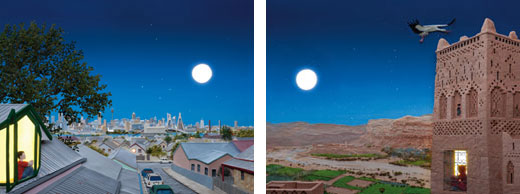

'Mirror' (2010) by Jeannie Baker

Jeannie Baker is an English artist who has lived in Australia for over 30 years. She is well known for her outstanding collage art that she frequently turns into children's picture books. You can read a review of her work on my blog 'Literacy, Families & Learning' (here). Her books usually have few or no words and typically offer some form of social commentary. She has written in particular about the impact of humanity on the natural environment.  But her latest work 'Mirror' is an attempt to challenge her readers to consider two families in two places - one in Sydney and one in Morocco. One we assume to be Christian and the other Muslim.

The concept for the book is brilliant, the quality of the images stunning, and the book design groundbreaking. The wordless picture book that she has created is, as usual, challenging at many levels. It is the concept and design that will first catch your attention. The book is slightly more square in shape, and it defies your efforts to open it in a conventional way. This picture book comprises two stories that are designed to be read simultaneously – one from the left, the other from the right (see below). As you pick up the book you try to open it from right to left only to have the book open at the middle to reveal two books, one that is read from left to right and begins in Arabic, and the other from right to left that begins with English. Page by page, we experience a day in the lives of two boys and their families - one from inner city Sydney, Australia and the other from a small, remote village in Morocco, North Africa.


Jeannie Baker conceived the book while travelling alone in Morocco. It was while immersed in the warmth and generosity of the Moroccan people and while experiencing the sights, smells, sounds and textures of the place, that she conceived the idea and knew she had to produce it even without approval from a publisher. Baker's book, in a sense, holds a 'mirror' to the world and produces a stunning and memorable insight into two families in two quite different places.

While the two worlds portrayed couldn’t be further apart, she shows through the parallel lives of the two families, a simple and profound truth. While people live in vastly different places, and have different lives, we share much. There is much that is different about the families. The book itself shows that language is different and how it is accessed is different. The illustrations and story show that religion, homes, landscape, transport, clothing, food, shopping, market places, daily tasks and family practices are different.  But there is also much that is the same. Family members love one another and depend on each other. A mother and father work each day and children learn, help at home and spend time with family. Children in Morocco do different things each day than in Sydney, but they are perhaps more like us than we might imagine. And there is an additional truth - we are connected to each other. With subtle use of images Jeannie Baker is able to show this connection. The delight of the reader is to discover these, with technology and trade as two examples. My grandson shouted excitedly as we read the book together for the first time "Look, look, it's the same carpet. The carpet they were making (in Morocco) is the same carpet they bought (the people in Sydney)".

How successful is Baker at communicating common humanity while not glossing over difference? Quite successful I think. While there are limits to what can be communicated with a wordless picture book, she offers a piece of literature that does more than offer a tokenistic view of common ground across two families and two different cultures.  This is a book that notes the differences while at the same time recognizing that we share humanity. Her book should be a challenge to Christians and non-Christians to be open to the embrace of the other. At the very least, books like this one offer a wonderful tool for conversations with our children about other people with different faiths and cultural practices.  For the Christian parent, the hope is that these conversations will lead our children to reflect the character and actions of our God revealed in the person of Christ. Our hope should be that they grow up to embrace the 'other’ in light of God’s mercy and grace in giving himself on the cross. Our hope should be that as they grow they would develop identities that meet Volf's challenge to ‘make space’ for the other and in doing so to offer paths for the sharing of their faith in Christ with humility, grace and love.

In a recent edition of Case magazine on 'Otherness' Mattheson Russell offered this sound advice:

"...the problem of otherness is no dry and abstract matter. It is a problem that is intimately bound up with fundamental questions we all face in the contemporary world: Is there anything more to life than acquisition, competition and violence? Dare we believe that it is possible to live with others - avowed and disavowed others - in communities of peace? Dare we believe that at the heart of the universe is an Other who is love?"

Literature is one simple vehicle that can be used by God to chip away our collective and individual fears and prejudices. As we learn about others and lead lives centred on Christ, we can be used by God to point 'others' to him.

Other posts

'To Exclude or Embrace: Considering Otherness' (HERE)

'Author Focus: Jeannie Baker' (HERE)

Thursday, 19 November 2009

To Exclude or to Embrace: Considering 'otherness'

Our next issue of Case magazine will consider how we relate to ‘the other’. As I ask in my introduction to the magazine, is this just a philosophical and theological discussion to keep scholars busy? Clearly, we see it as a topic of concern to all people. In his influential book 'Exclusion and Embrace' (which I mentioned in a previous post here), theologian Miroslav Volf shows just how important the question of otherness is to all of life. Understanding and living with others, is not simply a matter of accommodating diversity. He suggests our approach to the other should reflect the character and actions of our God revealed in the person of Christ. Volf challenges us to embrace ‘the other’ in the light of God’s giving of himself on the cross—this includes our enemies. We need to adjust our very identities to ‘make space’ for the other. We have four wonderful articles that address the theme.

1. Otherness and Continental Philosophy

Matheson Russell begins the issue for us by outlining the treatment of otherness in the field of continental philosophy. While much of philosophy has traditionally centred on the self, taking its cue from Descartes’ famous thinking ‘I', a concern for the other has emerged in more recent philosophical and theological works. Russell guides us through the work of key thinkers such as G. W. F. Hegel, Emmanuel Levinas, and Hannah Arendt, reflecting on the lingering presence of biblical themes in this literature. Emmanuel Levinas set the scene with his observation that the Western world tends to privilege the ‘same’ over the ‘other’. In such a world, the other counts only to the extent that he or she can be made the same, leading to behaviours of acquisition and domination. In Levinas’ work, says Russell, ‘the ethical demand of the other is the demand to let the other be, to break off the struggle for dominance…in short, to lay down arms and accept peace with the ‘other’ without reducing them to the ‘same’. Russell concludes by drawing on the work of Karl Barth, and by reflecting on the need ‘to relate to God as the absolute Other’, accepting his gift of grace and recognising Christ as Lord and Saviour.

2. A Theological View of Otherness

Moving from philosophy to theology, Linden Fooks asks what we can learn from Miroslav Volf. One of the pressing questions of our time is whether religion is a cause or a cure of cultural conflict. Volf’s answer, as Fooks shows us, is not ‘no religion’, but rather more, what he calls ‘thick religion’. His is a call to engage more seriously with the peace-making resources at the very heart of the Christian faith. This will require for Christians ‘an all-encompassing change of loyalty, from a given culture with its gods to the God of all cultures’ (Volf, p.40). Embrace—the theme of Volf’s major work, is not mere cheap reconciliation, but will require deep and costly forgiveness. Volf’s theological exploration of otherness and reconciliation has had an impact around the world.

3. Otherness and Disability

In our third article, Kirk Patston explores the issue of otherness and disability. Do we live in a land of ‘apartheid’, in which the disabled are systematically ‘othered’? Patston helpfully draws on the emerging field of disability theology to explore the portrayal of disability in the Old Testament. He asks and answers a number of fundamental questions. How can we reconcile the Bible’s call to welcome the alien and stranger with the way it appears to render certain groups, such as people with disabilities, as ‘other’? How are we to interpret the Old Testament’s complex portrayals of disability? Do postmodern critiques of these texts really fit? Patston reminds us that in the Old Testament ‘we do not meet the consistent, autonomous, rational adult that Enlightenment thinkers may have imagined. But we meet a humanity that is real.’

4. What it Means to Become ‘the other’

In our final article, Susannah Macready provides an insight into what it might mean to live with ‘the other’ and thus become ‘the other’. Her experience in entering the deaf community offers a humbling example of how we can experience otherness and yet find embrace. Her reflections on becoming an alien - becoming ‘hearing’ - are a timely reminder that relating to the other needs to be construed ‘less like an act of charity…and more like the initiation of diplomatic relations with another country, a country with an enviable language, culture and heritage.’

This is a challenging topic for all of us who live in pluralistic societies. How easy do we find it to embrace our neighbours, let alone our enemies? And in a more practical sense, how does this discussion challenge us as citizens as we collectively take responsibility for aliens and strangers. Does it inform our attitude to so-called boat people? What about the severely disabled, the homeless, the drug addict, the paedophile and so on? What does my understanding of the divine self-donation of the Cross mean for the construction of my identity and my relationship with the ‘other’ under the varied conditions of life? The writers in this issue have issued many challenges, I hope that many will read the issue and consider how to respond.

If you'd like to receive Case four times per year you can become a CASE Associate for just $55 per year. Single or multiple copies of specific issues of the magazine are also available.

Monday, 5 October 2009

'Exclusion & Embrace' - Identity, otherness and reconciliation

In our next issue of Case magazine (#21) we will examine 'Otherness'. The issue will offer a theological exploration of a topic that has long interested philosophers, sociologists and psychologists. Being able to define the 'other' (someone not like myself) is part of how we define the self. It is also the basis on which individuals, groups, communities and societies in general reject or distance themselves from other people; we use perceptions of difference to exclude rather than to 'embrace' (to use Volf's term). Miroslav Volf's work is central to much recent discussion of the topic and hence is important to the theme that we address. In his book 'Exclusion & Embrace: A Theological Exploration of Identity, Otherness, and Reconciliation', Volf suggests that understanding the problem of identity and otherness and the conflict that results, can be approached from multiple perspectives including that of the 'universalist' who seeks to control difference and instead promote common values, the 'communitarian' who seeks to celebrate all difference and promote heterogeneity, and the 'postmodernist' who wants to flee both of the above and seek instead the radical autonomy of the individual. But Volf (1996, pp 20-21) suggests that a Christian examination of otherness should take us in a different direction:
These proposals [i.e. the above arguments] do entail important perspectives about persons who live in societies, but their main interest is not social agents, but social arrangements. In contrast, I want to concentrate on social agents. Instead of reflecting on the kind of society we ought to create in order to accommodate individual or communal heterogeneity, I will explore what kind of selves we need to be in order to live in harmony with others. My assumption is that selves are situated; they are female or male, Jew or Greek, rich or poor - as a rule, more than one of these things at the same time...often having hybrid identities...and sometimes migrating from one identity to another. The questions I will be pursuing about such situated selves are: How should they think of their identity? How should they relate to the other? How should they go about making peace with the other?
Volf suggests that our starting point in this journey of discovery should be the cross of Christ, for it is the starting point to understanding the character of the Christian self in relation to the other. He suggests that Moltman's work (e.g. 'The Spirit of Life' 1991) offers insight into our need for solidarity with those who suffer and are excluded - "the sufferings of Christ are not just his sufferings but are those of the poor weak, which Jesus shares in his own body and in his own soul, in solidarity with them". As well, Moltman points to the need for atonement for the perpetrators of injustice - "just as the oppressed must be liberated from the suffering caused by oppression, so the oppressors must be liberated from the suffering caused through oppression". But Volf suggests we need to go further, we need to consider "divine self-donation for the enemies and their reception into the eternal communion of God" (Wolf, 1996, p. 23). In doing this, Volf seeks to consider the social significance of the theme of divine self-giving. God does not abandon the godless to their evil. Instead, he gives the divine self for them in order to receive them into divine communion through Christ's atoning sacrifice. As a result, he argues, we too should embrace our enemies. The metaphor of embrace he suggests is helpful in moving us in this direction. He describes it this way:
'The will to give ourselves to others and 'welcome' them, to readjust our identities to make space for them, is prior to any judgement about others, except that of identifying them in their humanity. The will to embrace precedes any 'truth' about others and any construction of their 'justice'. This will is absolutely indiscriminate and strictly immutable; it transcends the moral mapping of the social world into 'good' and 'evil'." (Volf, 1996, p. 29).
Volf's ideas are personally challenging for me, living in the relative comfort of a western nation with stable government and in a pluralistic society that at least claims to embrace the isolated, the weak, the disabled, the alien, the oppressed. While I see myself as a person with a sense of justice and a heart for the oppressed, I'm repulsed at times by the inner attitudes of my heart to the 'other' that may manifest themselves in politely ignoring needs, avoiding those who I see as different, condemning those who do evil and so on. I find it easy to embrace those who share much in common with me, but in my community how would I deal with the paedophile, the alien of radically different faith, the severely disabled, the homeless, the drug addict and so on. What does my understanding of the divine self-donation of the Cross mean for the construction of my identity and my relationship with the 'other' under the varied conditions of life?

If you are interested in these issues then check out Case. Case magazine is published quarterly. Issue 21 is due out in December. For more information consult the CASE website (here).