Showing posts with label children's literature. Show all posts

Tuesday, 12 June 2012

Could I visit the Narnia Exhibition & miss Christ?

I must confess I am a bit of a Narnia fan. Naturally, I am really looking forward to visiting the Narnia Exhibition which will be at the Powerhouse museum for the next few months. Whilst preparing for my visit to the exhibition I have visited the promoters website, and it left me slightly confused. The promoters detail a myriad of themes they believe C.S Lewis covers in his novels, they tell of the mythology and his imaginative narrative. Yet not a mention of Lewis' faith, or hint that the Narnia Series is a Christian allegory.  

Cogitating on this apparent oversight, I was reminded of Michael Ward’s article entitled 'C.S Lewis on imagination and story apologetics', which appeared in our last edition of Case Magazine issue #30

Ward reminds the reader that C.S Lewis is
………the most influential practitioner of Christian apologetics over the last hundred years. Works such as Mere Christianity, Miracles, The Problem of Pain, The Four Loves, and Surprised by Joy have been read by millions of people round the world……..
Yet as I join the throngs of crowds descending upon the museum to view the exhibition depicting Lewis’ imaginative works, I will be experiencing in person Ward’s proposition that it is indeed Lewis’
…seven Chronicles of Narnia which have been read most widely and exerted the greatest influence.
Michael Wards article analyses imagination, in theory and in practice, and describes how his narratives have influenced countless readers.   The article also suggests
….the Narnia stories reveal Lewis’s personal religion more profoundly than any of his more theological works.

I encourage you to pull out your copy of Case #30 and revisit Dr Michael Wards interesting article which dissects C S Lewis’ fantastic narratives. CASE Associates receive Case magazine 4 times per year as part of their benefits. For blog followers who are yet to be CASE Associates you can sign up HERE or order a single copy HERE. As for me, I will put aside my initial disappointment that the exhibition promoters seem to have ignored an obvious component of 'The Chronicles of Narnia'. I am sure the exhibition will spur on a new generation of C.S Lewis readers and the CASE article reminds me that  
…..these books where his imagination has full scope he presents the Christian faith in a more eloquent and probing way than ever his more straightforward books of apologetics could…..
And with that pleasing thought, I best be off….. I have an exhibition to visit!!!!!


(Details for the Powerhouse and the Exhibition can be found at the links provided) 

Wednesday, 8 June 2011

Christian ePicture Books for Children - Free giveaway (see below)

I did a post on Christian Book Apps for Children in January (here) in which I mentioned a series of books by Stanley and Jan Berenstain. The Berenstains are very well-known authors of a series of over 300 simple children's picture books. Many parents will be familiar with books like 'The Big Honey Hunt' and the 'Bear Detectives'. These simple books usually have no more than 300-500 words of different vocabulary. They are engaging and amusing stories about an endearing family of bears. They have many adventures and have been popular with children aged from 1-7 years for almost 50 years.

Christian publisher Zondervan and Oceanhouse Media have formed a partnership to produce a series of Berenstain books in eBook form that have Christian themes. The books include 'The Berenstain Bears Say Their Prayers', 'The Berenstain Bears Go To Sunday School', 'The Berenstain Bears And The Golden Rule' and 'God Loves You'. All are available for $US4.99.

Like all the Oceanhouse ePicture books, a simple format is used that incorporates the original artwork and text from the books. They have options to hear the book, read it yourself or auto play. They feature background audio and when you tap the pictures labels appear which can be read or heard. In the read aloud format their is word-by-word highlighting of text.

The books are an example of the type of Christian writing for children that I described in a previous post as 'Moral Tales' that are based on biblical verses or principles. How would I assess them? In short, they are an enjoyable and engaging series of stories that offer opportunities for parents to discuss moral issues and life according to Christian principles. Parents would certainly not see books of this type as a substitute for simply reading a good children's Bible with children, but as extra reading they would be helpful if parents are prepared to discuss the books.

Free PROMO codes

If you would like to download a free copy of 'The Berenstain Bears Go to Sunday School' for iPad or iPhone please contact me with a return email address and I will give you a code that you can use to redeem a download of the book.

Tuesday, 17 May 2011

The Invisibility of Christian themes in Blockbuster Movies

Regular readers of this blog know that I have written several times on the relationship between biblical narrative and literature HERE.  I have also called on Christians to consider turning their creative energies to the writing of literature for broader audiences.  Who will be the next C.S. Lewis or J.R. Tolkien? But perhaps there is a greater challenge facing Christians with film. David Dale in the Sydney Morning Herald has rather amusingly made the observation that it seems like every imaginable religious worldview is being represented in recent popular movies except Christianity.  He asks wryly "What has the Judeo-Christian system done for us lately?" He writes:
Transmigration of the soul, a belief of Hindus, Buddhists, and followers of the Jewish Kabbalah, is the trendy trope for screenwriters. A film called 'Source Code', which sold a  healthy 130,000 tickets during its first week in Australian cinemas, assumes a person's mind can be placed into the body of another person for the last eight minutes of person B's life (thus permitting person A to learn who murdered B). It's not so much reincarnation as preincarnation. Don't ask how the technology works. Just have faith.

'Inception' uses a similar principle, except that the soul-jumping happens when both parties are asleep. And in 'Avatar', human souls are transferred into bio-engineered alien bodies (on a planet whose inhabitants engage in Gaia worship, just to offer another option).

It's an amusing read but is there a significant message for Christians? How can we ensure that the Bible's central narrative themes are represented in literature and film? While there are plenty of films and books with Christian themes evident, he is commenting on recent blockbusters and the seeming dominance of other faith traditions at the moment. Of course, the trend begs the question is this evidence of people buying into other faith positions, or simply being willing to suspend their beliefs and reason to enjoy a good story? I'll let you judge that one, here's the trailer.

Thursday, 17 March 2011

Raising Boys Sights Above the Gross & Violent

In an article in the Wall Street Journal (24th Sept 2010) Thomas Spence suggested that if we want to teach boys to read, we should avoid "gross-out books and video-game bribes". We know that the difference between boys and girls in reading ability reflects an earlier start with language than boys and the fact that boys don't read enough. The question is why don't many boys seem to like reading as much as girls and what can we do about it? Spence lays the blame at the feet of video games and a diet of reading that is based on gross topics. He writes:
"One obvious problem with the SweetFarts philosophy of education is that it is more suited to producing a generation of barbarians and morons than to raising the sort of men who make good husbands, fathers and professionals. If you keep meeting a boy where he is, he doesn't go very far."

While, we can't simply blame the sins of a generation of boys on reading the wrong books and playing too many video games, Spence puts his finger on a key issue in the raising of boys. His comments resonate with some thoughts expressed by C.S. Lewis in his book 'The Abolition of Man'.

"St Augustine defines virtue as ordo amoris, the ordinate condition of the affections in which every object is accorded that kind of degree of love which is appropriate to it. Aristotle says that the aim of education is to make the pupil like and dislike what he ought. When the age for reflective thought comes, the pupil who has been thus trained in 'ordinate affections' or 'just sentiments' will easily find the first principles in Ethics; but to the corrupt man they will never be visible at all and he can make no progress in that science. Plato before him had said the same. The little human animal will not at first have the right responses. It must be trained to feel pleasure, liking, disgust, and hatred at those things which really are pleasant, likeable, disgusting and hateful."

The comments of Spence are probably a little unfair to the many authors who seek to engage boys with topics that focus on topics like gory death, macabre crimes, weird and unusual life forms etc? The philosophy of writers for boys like Raymond Bean who writes Sweet Farts, R.L. Stines who writes 'Goosebumps', and Terry Deary and others who write 'Horrible Histories' is to shock boys and to appeal to their interest in death, bodily functions, horror, blood and so on. Their overall aim (beyond selling books) is of course to get boys reading.

While the 'Butt' books by Andy Griffiths (and others) with titles like 'Zombie Butts from Uranus', seem to hit a fairly low mark in terms of linguistic complexity and their banality of plot that I'm not keen to see children read, there are other books like 'Horrible Histories' the work of authors like Dahl and others that have a place. Writing about gross or sensational topics can be done well or poorly. In limited quantities they can be helpful in motivating reading. The key is to make sure that this isn't all that boys read; that boys have their literary horizons expanded.

As Paul wrote to the Church in Philippi, we are to fill our minds with good things that will move us to worship God and serve others. We are to encourage our children to do likewise.
"Finally, brothers, whatever is true, whatever is honourable, whatever is just, whatever is pure, whatever is lovely, whatever is commendable, if there is any excellence, if there is anything worthy of praise, think about these things." Philippians 4:8
How can we use books and reading to train and mature the affections of the child?

The reading of literature as well as the Bible is a key way that we train the hearts of our children. Books give us opportunity to talk with our children about life; including their fears, hopes, desires, frailties, prejudices and so on. The more you can involve yourself in your children's early literacy experiences the better. Here are 6 things pieces of advice that might help.

1. Fathers and mothers need to work hard at listening to and reading with their sons. Share the experience of reading with your children. Read to them and with them as they grow older. I've written a post on my 'Literacy, Families & Learning' blog about how to do this (here).

2. If your boys find it hard to concentrate on books, tell them stories. You don't have to be a great storyteller, start by telling them about your childhood memories, your interests, real life stories etc.

3. Fathers or another adult male role model should have a key role in any boys' early literacy and learning development. Stretch the interests of your sons rather than trying to constantly appeal to their gross instincts.

4. Boys need help choosing books that they will not only like, but which they will be able to read. Take the time to help them. If they pick up a book with an exciting cover and find that they can't read it, this will be a disincentive. This will help to expand your boy's reading horizons.

5. The writers who are into 'gross' or unusual topics know that boys are more likely to be pick up books and read them when the books and the reading events offer opportunities to discover, experiment, explore, learn new things, laugh, consider the curious or unusual, help them to play, see how things work, share trivia, tricks and facts with other boys, explore the unknown, and generally do interesting things.

6. Read the Bible with your children from the first year of life. Make it interesting and exciting not a chore.

Other related posts I've written

'The Redemption of Children's Literature' (HERE)
Thomas Spence, 'How to Raise Boys Who Read - Hint: Not with gross-out books and video-game bribes', Wall Street Journal, 24th Sept, 2010 (HERE)
Post on 'Boys and Reading Success: Get them Reading' (HERE)
'Getting Boys into Reading Through Fiction' (HERE)
'Getting Boys into Reading Through Non-Fiction' (HERE)
'The importance of reading to and with your children' (HERE)
'Twelve great books for boys' (HERE)

Wednesday, 16 February 2011

Will the book survive?

I wrote a post on my blog 'Literacy, Families & Learning' back in 2008 about the possible death of the book (here) and concluded that it would survive. I've also considered recently the question 'Are Picture Books Dying?' (here) and have written a variety of other posts on electronic books, literacy apps and online reading.

A few weeks ago Nikki Barrowclough wrote an interesting article in the Good Weekend magazine of the Sydney Morning Herald, and framed it with the question "Can the book survive"?  This has motivated me to write on the topic again, because the question isn't simply can traditional publishing survive, or even literature for that matter. I think we need to ask a number of different questions:
  • Will literature survive? Yes! The form and delivery might change, but literature will be written and published.
  • Will paper books survive? Yes, but there will be casualties, with the most likely being some of the less adaptable publishers, libraries and bookshops.
  • Will sacred and religious books like the Bible survive in paper forms? I think so. While electronic forms will grow in use, I suspect that we will want to hold on to paper copies too.
  • Will scientific journals and reference books survive in paper form? No, I doubt it.
  • Will the way we read be changed by e-books? Yes, but we're still not sure what form the changes will take and many of us are doing research on this topic.
Two of my grandchildren enjoying reading on my iPad
The answer to the question Barrowclough posed is complex.  The book as an object will survive, but increasingly it will be in an electronic form rather than simply being a paper object. At the 8th International Conference on the Book (St Gallen, Switzerland) that I participated in during November, there were a number of sessions that considered the future of books. Amongst the presenters were representatives from three of the world's major publishers, academics, web content providers, IT specialists and librarians who collectively suggested that:
  • Scientific journals will cease to be produced in paper form within 5-10 years.
  • Increasingly, authors will publish e-books themselves, creating major problems for publishers and even bookshops.
  • Bookshops will only survive if they change to become places where lovers of books meet, chat, eat, share books (in whatever form) and purchase e-books and paper books as well as associated products. Some are already moving down this path.
  • The power of authors will increase as they realise that traditional publishing routes can be circumvented. This is happening already.
  • Libraries will survive but in different forms. They will continue to be archives for books and will still act as mediators for readers, but they will also be virtual hubs and gateways for online resources
  • Electronic libraries and virtual communities of readers will grow in importance and might well lead to more reading of 'books' not less.
  • There will be a different relationship to libraries with readers moving between virtual and 'real' sites for book exchange, discussion and advice; we already see this in universities where our students rarely visit 'real' libraries.
  • Children's literature will be much slower to move from paper to e-book formats, and may not make the transition completely. There are obvious challenges here and the book as an object has great significance for the younger reader; durability for the young toddler will also be an issue.
  • The importance of the book as an aesthetic object will remain; many of us will still want to hold, smell and stroke books, and visit great libraries like that at St Gallen (see the image below).
Some Challenges

There will be a lot of challenges as we negotiate this period of transition from paper books to far greater use of electronic books. At the moment the sales of electronic books are low in the non-scientific categories, but they will continue to rise.  What will this mean for our libraries? How do we ensure access to books for those without the resources to buy their own books online? How will we sustain libraries as 'real' communities where lovers of books dwell?

How will we ensure that as electronic forms of the book grow, that children (and adults) don't end up just 'playing' with books rather than reading them? I have already signalled in my post on e-picture books that children are easily distracted with e-picture books, and play much more with the interactive elements on electronic books than reading the text (here).

How do we make sure that the reading process isn't changed by electronic books (as it probably is) with detrimental effects for children (in particular) in comprehension, early learning and enjoyment? As well, what might be the impact on 'deep' reading of texts for adults?

How do we ensure the longevity of books? Is there a chance that the life of an electronic book might be substantially less than the paper book? Some of the world's greatest books have survived for over a thousand years; can we be confident that electronic storage will be able to match this? When I visited the medieval library of the Abbey of St Gall (St Gallen in Switzerland) in November I was amazed at the collection of 175,000 books and manuscripts some of which dated from the 7th century. Over 1,000 of their manuscripts have survived for over 1,000 years. I pondered my own inability, due to technology failings (& mould), to read old floppy disks containing the manuscript of my first book, in comparison with my ability to look at a map drawn in 650AD.

Part of the library of the Abbey of St Gall (St Gallen, Switzerland)
Some opportunities for Christian publishing

While I've voiced some concerns above, I also see great possibilities.

First, the most obvious one is that the Bible is now available free and online in many different languages and in audio forms. Readers also have the ability to increase font size at the touch of a button and translate books from one language to another.

Second, Christian books of all types will be available increasingly at cheaper prices making them more accessible.

Third, authors now have more power to publish and sell or give away their own books if they don't like what publishers do for them.  We have seen this already in Christian publishing with people like John Piper making their books available as free downloads.

Fourth, having books available electronically should increase our access to books in all their forms. Many of us marvel at how much easier it is to buy books today thanks to the Internet. Some of us (like me) have already discovered how much faster and cheaper it is to get books delivered to a reader like the iPad or the Kindle.

Fifth, there are now new opportunities to distribute the written word in association with images, sound tracks and supporting video material.

Sixth, having the Bible and biblical reference material available in digital form has changed the way many Christian scholars are able to work, mostly for the better.

Summing Up

There is no doubt that the electronic book is going to increase in popularity in the next few years.  This will cause some adjustments for readers. We need to make sure that nothing is lost in this transition and that all of the possibilities I mention above are realised. We have a great opportunity to increase access to the Bible and Christian teaching using electronic books. Rather than seeing the electronic book as a problem I have no doubt that we will embrace it and see its many possibilities. The paper book will still be important, especially for literature, children's books and sacred texts like the Bible, but the way we access books, share them and read them will continue to change.

Related resources & posts

'Can the book survive?' Nikki Barrowclough (HERE)
'Alice', the iPad and new ways to read picture books (HERE)
'Literacy and the iPad: A review of some popular apps' (HERE)
'The electronic book: The death of the book?' (HERE)
'Literacy and the iPad: A second review of children's literature apps' (HERE)
'Are picture books dying?' (HERE)

Friday, 28 January 2011

Ten Ways to Destroy the Imagination of Your Child

I write regularly about developing the imagination of children on my blog 'Literacy, Families & Learning' and have written from time to time on the CASE blog about the imagination, play and creativity. A new book by Anthony Esolen has motivated me to post on this topic again. Esolen is professor of English at Providence College in Rhode Island. He has written the book 'Ten Ways to Destroy the Imagination of Your Child'. Esolen's thesis, with which I concur, is that the way we raise, care for and educate our children, is increasingly destroying the imaginations and creative capacities of our children. He writes well, as you'd expect being an English professor, and draws heavily on the writers of classical and modern literature to reinforce his point.
The old alchemists of the early Renaissance sought the secret philosopher's stone, which would, in the right recipe, transform lead into gold. You can only transform gold into lead. This book is written to show you how to do that. The gold is nothing other than the child's imagination, which if it is not gold itself, can still work the miracle of old King Midas. "Nature only provides us with a leaden world," wrote the poet Philip Sidney, "but it is the poet that makes for us a golden one." If we can deaden the imagination, then, we can settle the child down, and make of him that solid, dependable, and inert space-filler in school and, later, a block of the great state pyramid.
Underlying Esolen's thesis is his belief that it is God himself who made us to imagine and that it is at least partly through our imaginations and longings that we seek him and experience all that he intended for us.

Some readers who love language and literature less than I do, will find his constant use of literature, and in particular the classics, distracting and maybe even a little pretentious. But this is his passion and interest and language and literature are major foundations for imagination and creativity. Even as one not educated at school with Homer, Aristotle, Dickens, Chaucer, the poetry of Philip Sidney and the music of Bach, I was swept along by his use of the great texts. Esolen uses a wonderful cross section of literature, music and even art to make his simple points about the nature of imagination, its ultimate purpose, and the dangers of shutting it down in our children. The writing is ironic in style as the title suggests. At times this seems a little forced but overall, for me, it works powerfully.

In my view, as an educator, his 10 'Methods' that will destroy the imagination of children, do bring into focus that which can stifle learning and close down the possibilities for the imaginings of children. As we do this, we also reduce their ability to solve problems, write with voice and effectiveness, and be transformed (or at least shaped) by the language and power of literature.

Esolen's 10 Methods to destroy the imagination

1. Begin by rearing children almost exclusively indoors - give in to the threats of the outdoors, don't risk allowing them to have unbridled experiences out of our observable space. Lock them up in classes and organised instruction and avoid giving them opportunities to run free.

2. Never allow children to organise their own worlds of exploration of that which is interesting or challenging - replace the spontaneous and child initiated and replace it with 7 days of structured activities controlled by others and a timetable that leaves no scope for exploration, time wasting and contemplation.

3. Don't risk allowing children to explore machines or encounter those who know and use them - privilege safety above all things, cut craftsmen from the child's world, despise practical and craft knowledge, forget about the challenge and fascination of maps, diagrams and the like.

4. Replace fairy tales with cliches and fads - water down stories to remove the evil and violent, look for tales that 'flatten' and homogenise, replace fundamental truths with cliches and ideological manifestos.

Odysseus
5. Denigrate or discard the heroic and patriotic - remove fathers who are heroes, men who are warriors, lose sight of the 'piety' of a place like the Welsh uplands and coal mines of Richard Llewellyn's 'How Green was My Valley'. Ignore the dignity of simple people and their ways.

6. Cut down all heroes to size - don't allow a sentimental admiration of a hero, dismiss courage, beat from our boys any hint of hero worship. Instead grow men 'without chests' who spend hours on violent video games but never rumble in the back yard.

7. Reduce all talk of love to narcissism and sex - replace the music and tenderness of love in the Odyssey, or the poetry of Stephen Foster for a lost love, with a reduction of love to the mechanics of sex, "reduce eros to the itch of lust or vanity". Replace the first pangs of curiosity of a boy for a girl, or a girl for a boy, with a bombardment of images of what love isn't.

8. Level all distinctions between man and woman - just as individual personalities are washed from our classrooms, so too, reduce all differences of gender, and convince children that boys and girls are just the same.

9. Distract the child with the shallow or unreal - fail to encourage the child to hear and sharpen the senses before creating, abolish solitude and silence, fill the child's life with the 'noise' of television, video games and other forms of banality. Don't just give decibels of noise but rather, more importantly, mental and spiritual interference. Separate the child from the relationship of family, neighbours and friends and place them in after school care, preschools etc.

10. Deny the transcendent - deny the idea of God, ignore the mystery of faith and religion, ensure that unlike the ancients in the caves of Lascaux there is little opportunity to contemplate and create a veritable cathedral born of their imaginings. Do everything possible to erase any opportunity for your child to search out the inscriptions of praise on each human heart.

Summing Up

Esolen has put his finger on something important. He isn't the first person to write about imagination and as he suggests himself, he's probably not the best-qualified person to do so either. But his book reminds us that imagination is not just a cognitive state to be prodded and used for the banal or even the practical. In fact, it has moral dimensions that can be seen in a biblical anthropology of personhood. A view of the person that sees the ability and desire to imagine as part of God's blueprint for his people.

Esolen also offers a useful social commentary on the tendency to seek the banal rather than that, which is rich and complex. His ironic commentary on approaches to teaching and child rearing that value the tangible and measurable, rather than the whimsical and creative is helpful, although in places a touch too simplistic. One example of this is that in dismissing technology and in rightly pointing to the abuses of gaming and television and their ability to distract from friends, play, exploration etc, he fails to acknowledge that technology can expand the imagination too. Technology can open up a world of new facts that trigger exploration, or offering opportunities to create images, videos and complex texts that expand the imagination.

Some won't like Esolen's ironic style, for there is a danger in its over-use. At times it tends to give the sense that Esolen is trivialising the issues and ignoring complexity and ambiguity.  This might lead some not take Esolen's arguments seriously. This would be a pity for there is much wise advice in this book.  

Esolen offers a timely and beautifully written analysis of pop-culture and a world where we 'flatten' the view of what it means to be men and women, we lose a vital focus on moral centring and values, we accept an impoverished view of childhood, and we replace love for lust, the thirst for the deep with the shallow and flood children's lives with banality instead of richness. This book will have non-Christian detractors, but it will also stimulate discussions concerning the loss of childhood and the place of the imagination not just in life but also in grasping something of the transcendental and an existence beyond this life. As Esolen reminds us:
The imagination opens out not principally to what it knows and finds familiar, but to what it does not know, what it finds strange, half hidden, robed with inaccessible light. The familiar too can be an object of wonder, but not by its familiarity... 

Some Other Practical Posts for Parents and Teachers Interested in the Imagination

1. 'The Importance of Simple Play' (HERE)

2. 'The Role of Adults in Children's Play' (HERE)

3. 'The Dangerous Book for Boys' (HERE)

4. 'Understanding and Developing Creativity' (HERE)

Thursday, 13 January 2011

Christian Book Apps for Children

Some of the readers of this blog know that I also write a blog concerned with 'Literacy, Families and Learning'. In the last month I have been considering the impact that ePicture books might have on children's reading (you can read some of these reviews HERE). While communication technology isn't without potential problems (some of which I have written about in the past on both blogs), it also offers some great possibilities. I am interested in how ePicture books and even just electronic Bibles for devices like the iPad, iPod and iPhone might impact on children's growth as readers but also in terms of their knowledge and faith in God.

1. ePicture Books that teach about our relationship to God

One example of the apps emerging in this category are a series of books by Stanley and Jan Berenstain. The Berenstains are very well-known authors of a series of over 300 simple children's picture books. Many parents will be familiar with books like 'The Big Honey Hunt' and the 'Bear Detectives'. These simple books usually have no more than 300-500 words of different vocabulary. They are engaging and amusing stories about an endearing family of bears. They have many adventures and have been popular with children aged from 1-7 years for almost 50 years.

Christian publisher Zondervan and Oceanhouse Media have formed a partnership to produce a series of Berenstain Bear books that have Christian themes. The titles include 'The Berenstain Bears Say Their Prayers', 'The Berenstain Bears Go To Sunday School', 'The Berenstain Bears And The Golden Rule' and 'God Loves You'. All are available from $US3.99.

Like all the Oceanhouse ePicture books, a simple format is used that incorporates the original artwork and text from the books. They have options to hear the book, read it yourself or auto play. They feature background audio and when you tap the pictures labels appear which can be read or heard. In the read aloud format their is word-by-word highlighting of text.


I reviewed 'The Berenstain Bears and the Golden Rule'. As you'd expect the story illustrates the Jesus teaching in Matthew 7:12. As usual, the Berenstain write an engaging and enjoyable story. It adequately illustrates the verse in terms that children will understand. It would offer a good opportunity for parents to discuss situations that the child has found themselves in at school or at home where they have felt excluded as well as other applications.

These books are an example of the type of Christian writing for children that I described in a previous post as Type 4 ('Moral Tales') that are based on biblical verses or principles. How would I assess them?  In short, they are an enjoyable and engaging series of stories that offer opportunities for parents to discuss moral issues and life according to Christian principles. Parents would certainly not see books of this type as a substitute for simply reading a good children's Bible with children, but as extra reading they would be helpful if parents are prepared to discuss the books. However, I have to say that there is nothing that the Oceanhouse ePicture books offer that an ordinary book cannot do. There will be better examples of apps of this type in the future, that will offer greater interactivity and use of the technology to do more than a conventional book. At the moment, the Oceanhouse developers are simply offering the normal book plus the ability to touch pictures and read labels. Frankly, this is simply a distraction from the ultimate purpose of these books, which presumably is to teach children about God and our relationship to him.

2. Bibles and Bible resources

BCN multimedia has recently released their new Children’s Bible 3.0, which improves on their free app for iPhone and iPod to enable it to work with iPad. It is published in 7 languages. You can purchase a range of Bible comics, videos and stories in two ways. You can download your own version of the major products like the New Testament or Old Testament comic ($5.99US each), or you can download a free version of their Bible Comic that will give you a different section of the Bible each week (for $US2.99). In the second purchase format there are three sections in each of the old and New Testaments - 'The Genesis', 'The Exodus', 'Kings and Prophets' for the OT and 'Birth of Jesus', 'Parables and Miracles', 'Passion of Jesus Christ'. You can also purchase individual Bible stories. In the free format you will be will 'pushed' varied products each time you open it. I found this frustrating and would recommend simply purchasing the Old and New Testaments if you want this app. Having said this, I'm not sure I'd buy the apps for the purposes of my children's biblical education. The comic book format will be appealing for children but the apps offer no more than this. There are no additional interactive features or even sound. The comics use simple language that most 6-12 year olds will be able to read and like any comics they have frames that have no words.

The version of the Bible used isn't made clear in the apps, although they acknowledge that they revise some parts of Scripture. It seems a relatively faithful use of Scripture in a form that looks like they may have use a modern translation like Good News as the foundation of the text.


The apps that are purchased are colourful and easy to navigate (great slide control at the bottom - see image below) and are available in English, French, German, Italian, Portuguese, Spanish, and Catalan. You can read the comic books on an iPhone, iPod or iPad. The new version allows a sharing feature for favourite scenes by e-mail, Twitter and Facebook.


BCN have done an impressive job with the comics. I suspect that many children will enjoy reading the Bible and its major stories in this format. The product will increase children's familiarity with the overall biblical narrative as well as the major stories that they would hear in any Sunday school. Children would also be able to use and enjoy them independently in the back of the car, in bed or wherever.  But if your children already have a good grasp of the biblical narrative and central themes of Scripture, apps of this type won't be a substitute for some of the many wonderful children's Bibles and independent study tools that are available in book format. It also won't be a substitute for parents sitting with their children to read and discuss the Bible. While you could read the comics together on the iPad, I don't see this as the way the product would be best used. As independent reading, or as an addition to good Bible study with parents, they have value.

I'm looking forward to see what major publishers of children's Bibles like Lion Hudson will do in this area.

3. Christian teaching aids

While there are many Bible activity books and games available on the Web for downloading (many of which are rubbish educationally and biblically), there is little available as yet for devices like the iPad and iPhone. Frankly, I don't see this as a problem, but there will be great possibilities for Christian educators to use devices like the iPad in combination with smart boards and data projectors in time. I haven't seen anything (as yet) that I'd recommend but I'd be happy to hear from others who know of emerging products for this market.

Summing up

It's early days with the development of apps for children's books, let alone specialist products like Christian Bibles and relevant Christian literature. The early attempts are interesting and will be received well by children but at this stage they have some way to go to harness the enormous potential that there is for the presentation of narrative material on devices like the iPad. The worst products will be those that simply put paper books on the iPad. The best products will be those that do the following:
  • Remain faithful to the texts that they are using (e.g. use the best available translations of the Bible and don't tamper with it, other than faithfully paraphrasing if necessary).
  • Use the complete package of features that are available on a device like the iPad to present exciting versions of known and new stories using sound, colour, video, linked resources and interactivity.
  • Don't trivialise stories by adding on features that have little to do with the story and the overall intent of the app. For example, why ruin a good story by making every page an opportunity to drill sight words.
  • In the case of apps that present the Bible, developers need good advice from theologians and children's educators to ensure that they do more than just present traditional Bible stories. While our children still need to know and understand these stories, they will need to be read and understood by children within the overall themes of Scripture. This is a plea for some understanding of Biblical Theology when embarking on product development.
Other links

'Alice', the iPad and New Ways to Read Books (HERE)
Literacy & the iPad: A Review of Some Popular Apps (HERE)
Literature & the iPad: A Second Review of Children's Literature Apps (HERE)
Other posts I've written on children's literature on the CASE blog (HERE)

Tuesday, 9 November 2010

God's Story Reflected in Children's Literature

I have been an academic for 30 years and a Christian for 26 years.  At first when I became a Christian I struggled to see connections between the life I was living day by day, and my new life of faith as a believer in Christ. But as I grew in my understanding of the Bible I began to see the presence of God in my work and my study.  As an academic interested in how children learn I have maintained a long-term interest in literature and its power not just to teach about language and life, but also to enrich our lives and even transform the way we think about our world. Over time, I have come to realise that stories, even when created by non-believers in Christ, contain echoes of the central meta-narrative of the Bible.

The focus of the Bible is Salvation History, with its central narrative tracing both the history of Judaism and Christianity and God’s redemptive plan for his people. In the beginning God created…and it was good. But sin entered the world, man rebelled against him and so God placed a curse upon his creation that one day would end in judgement. But God always had a plan for such rebellion; a plan of redemption motivated by love. An amazing gift of grace; his own son sent to die and three days later to be raised from the dead to defeat sin and death. A plan that provided a way for his creation to be restored to a relationship with him. Salvation for those who repent of their sin, seek the mercy of God and in faith commit their lives to following Jesus. This is the meta-narrative of the Bible.

You don't have to go far to begin to see how literature often echoes (even if imperfectly) God's foundational story of salvation told in and through the life of Christ. J.R.R. Tolkien once said (to C.S. Lewis) that “The Christian story is the greatest story of them all. Because it’s the real story. The historical event that fulfils the tales and shows us what they mean.”

Lewis and Tolkien both saw the gospel narrative as the central or foundational human narrative. The rescue of a pig by a spider in a children's story, which at one level might seem trivial, is a faint echo of the ultimate act of sacrifice of God in redeeming his children through the sacrifice of his Son. The real event ultimately fulfils the literary narratives and makes sense of them. After studying children's literature for over 30 years I have come to see the wisdom of Tolkien's comment. There appear at least 5 main ways that Christian writers of children's books can point their readers towards God's divine narrative of redemption:

Type 1 – Stories that directly present the Christian gospel explicitly, often in the form of the retelling of Bible stories suitable for children. Children’s Bibles and collections of Bible stories fall into this category.
Type 2 – Stories that allegorically present the gospel (e.g. John Bunyan’s Pilgrim’s Progress).
Type 3 – Stories that present or address essential biblical understandings and teaching; where the key elements of the Biblical plan of salvation are woven within the story, or can be seen as explicitly reflecting the key elements of the divine narrative (e.g. J.R.R. Tolkien’s Lord of the Rings and The Chronicles of Narnia by C.S.Lewis). While some would see the latter as allegory, Lewis denied this and instead claimed that the narrative came first and the biblical parallels followed.
Type 4 – Moral tales that have direct biblical parallels or that reflect moral principles consistent with the Bible’s teaching (e.g. evil will be punished; sin has consequences; honesty is better than falsehood). Nursery rhymes and many fairy tales fall into this category, as do many cautionary tales (of course not all such tales reflect biblical moral insights, but many do).
Type 5 – This is really a variation or extension of the above. Here the links or parallels are at the thematic level rather than in the form of moral teaching. Stories of this kind demonstrate or echo biblical teaching (e.g. salvation narratives, stories of redemption, parallels to biblical narratives or parables). These narratives parallel the gospel narrative without explicit commentary. Such stories can be read at one level as simply a nice tale, but at another level the key themes parallel biblical themes that can be discussed.

I have suggested before (here) that types 2-5 offer special potential for audiences beyond the children of Christians. The following demonstrate some type 5 examples of what I mean.

Example 1 – “Charlotte’s Web”, by E.B. White

This is a well-known book written for 6-10 year olds. It is a beautifully written tale about a group of talking farmyard animals, a spider, a rat and a little girl named Fern. While it makes no attempt to teach the gospel narrative, or even disguise it within an allegorical telling, it has themes that parallel key themes within the biblical gospel narrative. At one level, it is the celebration of loyalty, love and friendship. But it is also a salvation narrative. The story of a runt pig rejected by the farmer, sentenced to death but then rescued first by a small girl and later by the work of an intelligent and literate spider. At this thematic level, the narrative points to the power of faith, hope, love, charity, sacrifice and new life.

Example 2 – “Why do you love me?” by Martin Baynton

This is a beautiful little picture book written for 3-6 year olds. It is essentially a dialogue between a dad and his little boy, prompted by the boy’s question, “Do you love me?” This is one of those conversations that only a parent could full appreciate. The little boy asks, “Why do you love me?” “Do you love me because I’m kind?” “..brave?” “..funny”? “…clever”? “…good”? “…naughty?” To each question the Dad says “Yes”. “So why do I try to be good” says the boy. “You tell me,” says his dad. “Because I love you too”, replies the boy. The echoes to the biblical account of God’s grace are evident. Like God whose love towards us is an unconditional act of grace not linked to who we are and what we do, the father loves the boy in spite of who he is and what he does unconditionally. He loves him through the good and the bad. And the boy, in response to the love of the father, loves his father as well and seeks to please him.

Example 3 – “The Delivery of Dancing Bears" by Elizabeth Stanley

This is a picture book written for children aged 4-7 years that is essentially a contemporary fable, although it was written in opposition to the cruelty that 'dancing' bears had experienced in many countries.  The dancing bear is enslaved and mistreated at the hands of a cruel man who uses her to entertain people in the market square of a village in Turkey. The bears hope of freedom keep her alive until one day a noble peasant comes to rescue the bear by paying the cruel owner a ridiculous price (all he had in the world) well beyond what the bear was seen as worth by its keeper. This great act of grace frees the bear and the old man Yusuf takes her back to his humble cottage near a stream and loves it back to a life of freedom from the fear and pain of the past.

The story is centred on an act of great mercy from the old man, who gives all of his earthly wealth to rescue the bear.  This is a story of rescue from slavery, redemption due to the love, grace and mercy of Yusuf and the bear's ultimate restoration to the life she was meant to live.

The Special Merit of Children's Literature

There is great merit in Christians seeking to write literature in its many forms for children. Such writing needs first to meet the basic criteria for good writing – good tales well told; language used well; narratives that work at multiple levels; rich authentic characters; interesting ‘page-turner’ plots. But beyond this they should:
  • offer knowledge that is a celebration of God’s world and his purposes;
  • act as a mirror allowing the reader to reflect on life and their future;
  • lead us to consider aspects of the human condition (life and death, fear, loneliness, pain, loss, frailty, brokenness etc);
  • point to the central redemption narrative of the Bible.
What is important to stress is that Western literature is an essential communicator of cultural traditions that reflect the central biblical narrative of Christ. Good books, shaped by Christian understanding, offer an opportunity for the essential foundations of the biblical narrative to be communicated in stories that connect with children's contemporary world.  This offers a bridge to the biblical narrative and its life-changing opportunity to be repent and believe in Christ.

Related Links

This post appeared in a different form in a post I write in 2008 ('Christian writing for children - Part 1')

'Christian writing for children' - Part 2 (here)

Sunday, 12 September 2010

Children's Literature and 'Otherness'

In his influential book 'Exclusion and Embrace', theologian Miroslav Volf shows that understanding and living with the 'Other' - that is one unlike ourselves - is not simply a matter of accommodating diversity. He suggests that our approach to the 'other should reflect the character and actions of our God revealed in the person of Christ. Volf challenges us to embrace ‘the other’ in the light of God’s giving of himself on the cross—this includes our enemies. We need to adjust our very identities to ‘make space’ for the other. This is a challenge for all people. 

Australia like many Western democracies has experienced a diversification of immigrants coming to our shores in the last few decades. Almost all of us are immigrants in this country, with the exception of Indigenous Australians who make up about 3% of the population. With each new wave of immigration there have been tensions as fear of the impact of new residents has led some to question immigration levels (see my previous post on 'Dispelling the Myths of Boat People').

Volf's work is a counter to other responses to increasing population diversity and struggles to deal with difference. While some see the celebration of multiculturalism as solution enough to a fear of others, such views are simplistic. While multiculturalism has the potential to encourage the recognition of different cultures and the valuing of all people in spite of difference, there is a danger that while celebrating diversity in cultural practices, we may simply mask deep-seated fears and prejudices. In other words, we might be happy and comfortable with others as long as we can see ourselves in them. At the base of opposition to immigration is often a fear of what we don't know about other people. Can literature help to break down such fears?
 
Embracing the 'other' through literature


Literature can be a great help in developing tolerance and in breaking down fear of the other, but like multiculturalism it can also gloss over differences. As continental philosopher Emmanuel Levinas argued, Western tradition has tended to privilege the 'same' over the 'other', acknowledging the 'other' only to the extent that they can be 'made' to be like us. While it is easy to see this tendency in the colonial domination of nations and people, Levinas argues that we are slower to recognize it in our individual actions and thinking towards others, resisting (or quietly ignoring) difference and embracing that which we recognize in ourselves.

If authors fall into this trap their work will do little to reduce the fear of the other; rather, it might simply smudge out the inconvenient differences, such as religious beliefs, while underlining that which is common in our shared humanity. This might lead to little more than a shallow acceptance of others that is tested when our world is impacted even in small ways.

In the educational field multicultural literature programs have been seen as a valuable way to fight racism. But while literature has the potential to hold a light to what is common and different, it can also represent an ideological quest to remove that which has been judged to be wrong and oppressive because it is different. For example, much post colonial literature in seeking to legitimately offer new voices from previously unheard groups, can easily villianize previously dominant views of the world. Christianity has received much blame for such oppression, as have white males. This is not to ignore the fact that both groups have been responsible for wrongs, but if literature is to offer a critique or counter to racism and fear, then it must do more than blame others; it must encourage us to consider, listen to and understand others.

With the above in mind we need to view any piece of literature that deliberately sets out to offer an alternative reading of our times with healthy analysis. There is an even greater need to adopt a questioning stance when the literature has been written for children.  A recent example is worthy of consideration.


'Mirror' (2010) by Jeannie Baker

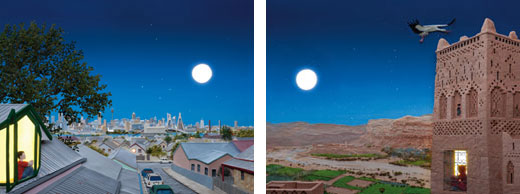
Jeannie Baker is an English artist who has lived in Australia for over 30 years. She is well known for her outstanding collage art that she frequently turns into children's picture books. You can read a review of her work on my blog 'Literacy, Families & Learning' (here). Her books usually have few or no words and typically offer some form of social commentary. She has written in particular about the impact of humanity on the natural environment.  But her latest work 'Mirror' is an attempt to challenge her readers to consider two families in two places - one in Sydney and one in Morocco. One we assume to be Christian and the other Muslim.

The concept for the book is brilliant, the quality of the images stunning, and the book design groundbreaking. The wordless picture book that she has created is, as usual, challenging at many levels. It is the concept and design that will first catch your attention. The book is slightly more square in shape, and it defies your efforts to open it in a conventional way. This picture book comprises two stories that are designed to be read simultaneously – one from the left, the other from the right (see below). As you pick up the book you try to open it from right to left only to have the book open at the middle to reveal two books, one that is read from left to right and begins in Arabic, and the other from right to left that begins with English. Page by page, we experience a day in the lives of two boys and their families - one from inner city Sydney, Australia and the other from a small, remote village in Morocco, North Africa.


Jeannie Baker conceived the book while travelling alone in Morocco. It was while immersed in the warmth and generosity of the Moroccan people and while experiencing the sights, smells, sounds and textures of the place, that she conceived the idea and knew she had to produce it even without approval from a publisher. Baker's book, in a sense, holds a 'mirror' to the world and produces a stunning and memorable insight into two families in two quite different places.

While the two worlds portrayed couldn’t be further apart, she shows through the parallel lives of the two families, a simple and profound truth. While people live in vastly different places, and have different lives, we share much. There is much that is different about the families. The book itself shows that language is different and how it is accessed is different. The illustrations and story show that religion, homes, landscape, transport, clothing, food, shopping, market places, daily tasks and family practices are different.  But there is also much that is the same. Family members love one another and depend on each other. A mother and father work each day and children learn, help at home and spend time with family. Children in Morocco do different things each day than in Sydney, but they are perhaps more like us than we might imagine. And there is an additional truth - we are connected to each other. With subtle use of images Jeannie Baker is able to show this connection. The delight of the reader is to discover these, with technology and trade as two examples. My grandson shouted excitedly as we read the book together for the first time "Look, look, it's the same carpet. The carpet they were making (in Morocco) is the same carpet they bought (the people in Sydney)".

How successful is Baker at communicating common humanity while not glossing over difference? Quite successful I think. While there are limits to what can be communicated with a wordless picture book, she offers a piece of literature that does more than offer a tokenistic view of common ground across two families and two different cultures.  This is a book that notes the differences while at the same time recognizing that we share humanity. Her book should be a challenge to Christians and non-Christians to be open to the embrace of the other. At the very least, books like this one offer a wonderful tool for conversations with our children about other people with different faiths and cultural practices.  For the Christian parent, the hope is that these conversations will lead our children to reflect the character and actions of our God revealed in the person of Christ. Our hope should be that they grow up to embrace the 'other’ in light of God’s mercy and grace in giving himself on the cross. Our hope should be that as they grow they would develop identities that meet Volf's challenge to ‘make space’ for the other and in doing so to offer paths for the sharing of their faith in Christ with humility, grace and love.

In a recent edition of Case magazine on 'Otherness' Mattheson Russell offered this sound advice:

"...the problem of otherness is no dry and abstract matter. It is a problem that is intimately bound up with fundamental questions we all face in the contemporary world: Is there anything more to life than acquisition, competition and violence? Dare we believe that it is possible to live with others - avowed and disavowed others - in communities of peace? Dare we believe that at the heart of the universe is an Other who is love?"

Literature is one simple vehicle that can be used by God to chip away our collective and individual fears and prejudices. As we learn about others and lead lives centred on Christ, we can be used by God to point 'others' to him.

Other posts

'To Exclude or Embrace: Considering Otherness' (HERE)

'Author Focus: Jeannie Baker' (HERE)

Thursday, 13 November 2008

The Redemption of Children's Literature

1. The importance of children's literature

Some readers of this blog know that I also write a blog called "Literacy, families and learning". This blog aims to "to provide practical, timely and sound support and advice for parents, teachers and teachers in training". It isn't written with a specifically Christian audience in mind, but if you read it I hope that you will see the influence of my Christian worldview. This has been perhaps most evident in some posts that I've been doing on Key themes in children's literature.
These posts intersect with two posts I wrote on this CASE blog in August about Christian Writing for Children (here and here). I suggested in my posts on writing that in the Western cultural tradition the gospel of Christ is the central narrative to which virtually all other narratives have some relationship. The central focus of the Bible is Salvation History; with its central narrative tracing both the history of Judaism and Christianity and God’s redemptive plan for his people. In the beginning God created…and it was good. But sin entered the world, man rebelled against him and so God placed a curse upon his creation that one day would end in judgement. But God always had a plan for such rebellion; a plan of redemption motivated by love. An amazing gift of grace; his own son sent to die and three days later to be raised from the dead to defeat sin and death. A plan that provided a way for his creation to be restored to a relationship with him.

In my first post on Christian writing for children, I suggested that while there are many legitimate forms of writing for children (I suggested at least five types), I urged Christians to consider writing good fiction for the secular marketplace. In a sense, I was arguing for the redemption of children's literature for the sake of the gospel by having more Christians writing good narratives for children.

2. The place of God's redemptive plan for creation in literature


In this post I want to go further and suggest that much literature is already suitable for parents to use as an extension of the biblical education of their children. While I'm not suggesting that literature can be a replacement for the Bible as the key text for life, what I am suggesting is that the gospel inhabits literature in stories that echo the central redemption narrative of the Bible. I've written three posts in my Key themes series:

The environment
Death
Being different

3. Making better use of literature

I wrote in one of my books written for academics and university students (Pathways to Literacy, Cairney 1995, p.77-78) that literature can act as:
  • a mirror to enable readers to reflect on life problems and circumstances
  • a source of knowledge
  • a source of ideological challenge
  • a means to peer into the past, and the future
  • a vehicle to other places
  • a means to reflect on inner struggles
  • an introduction to the realities of life and death
  • a vehicle for the raising and discussion of social issues
I'm pushing the above claims one step further. My point is simple. For many books, there are links or parallels at the thematic level with the biblical redemption narrative. Many stories demonstrate or echo biblical teaching (e.g. salvation narratives, stories of salvation and redemption, parallels to biblical narratives or parables). Others simply distort these biblical themes and require comment and critique. Such stories can be read at one level simply as nice tales, but at another level the key themes that parallel biblical themes can be discussed with children. In many cases, the authors are not Christians, but Christian teaching has indirectly influenced their writing. Many children's stories:
  • offer knowledge that for the Christian affirms that God is in control of his world and is unfolding his purposes for it;
  • act as a mirror allowing the reader to reflect on life and their future in the light of biblical teaching;
  • lead us to consider aspects of the human condition (life and death, fear, loneliness, pain, loss, frailty, brokenness etc) that once again relate to biblical wisdom and teaching;
  • point to the central redemption narrative of the Bible.
Alternatively, literature can offer perspectives that are at odds with biblical teaching and require comment. This type of critical reading of literature against the grain is a vital skill for children to learn, so that as independent readers they will be better able to read books, view movies, listen to songs and read texts of all kinds with a biblical lens. This type of biblical engagement with literature can begin very early (albeit in modest ways!).

4. An example - Teaching our children about death, human frailty and judgement

The topic of death is not a very popular one for some parents. Many parents make the mistake of trying to hide the reality of death from their children with the result that when their children do encounter it they may have difficulty coping. At this point I should confess to telling my eldest daughter when she was about 3 years old that our pet yellow budgerigar ("Mr Hooper") had got out of the cage and flown away, when in fact he had died. As non-Christian parents at the time, we weren't ready to deal with the topic so we simply lied about the bird's death (sorry Nicole!).

While there is little point in deliberately raising death prematurely for the child before they have the emotional maturity to deal with it, it's hard to artificially put a time frame on when it's a good time to speak of death.
While thankfully few children will have to deal with death and dying at too young an age, some will, and of course we have no way of knowing when and if this might be the case. Furthermore, from an early age they will be on the 'edges' of conversations and discussions that will give them their first hints that this life is not permanent for any living creature. An awareness of death may emerge very early with the death of a family member, or more commonly, through the death of an animal (typically a pet like Mr Hooper). However, more often the child's first awareness that all living things will one day might be through a book or a film, DVD or television program. As the child grows older the chances of some first-hand experience of death will increase. By the teenage years a close experience with the death of a friend or loved one will be more common, and might well come in tragic circumstances.

That's where literature (and film of course) can help parents, in particular, to discuss the reality of death with their children. Books that address death can be read with children and by children themselves as a source of insight, comfort and emotional growth. Once again, I stress that this isn't a replacement for the Bible's discussion of death, but is a complement to our discussion of the Bible's teaching about death. At this point, I should stress that I am not deliberately ignoring classic works of Christian fiction that are more allegorical in their approach such as Bunyan's "The Pilgrims Progress", The Chronicles of Narnia written by C.S. Lewis and even new works like R.C. Sproul's children's book, The Prince's Poison Cup. This genre has a different place in our literary traditions that I won't address in this already long post.

Let me offer a few examples of how some books raise the theme of death and dying.

5. Some books that deal with death

a) Traditional fantasy and fairy tales

Fantasy has always been a common introduction to human frailty and death. Fairy tales from many different cultural traditions have not been afraid of death as a theme. Traditional versions of 'Little Red Riding Hood', 'The Three Pigs', 'Jack and Beanstalk', 'The Gingerbread Man', 'The Little Match Girl' and many other tales, all dealt with death in graphic detail. However, today it is common for such tales to be sanitised and death expunged or pushed into the background of the narrative. But traditional fairy tales, myths and legends still offer a rich array of stories that deal with death. In contemporary literature there are also many good examples of books that deal with this important theme.

b) Some books for younger readers (0-6 years of age)


I’ll always love you
, Hans Wilhelm – a delightful picture book that tells of the death of a little boy’s dog called Elfie and the impact of the death on him. This would be appropriate for children aged 3-7 years. There is so much to talk about in this story of devotion and loss. Be warned, children ask the most challenging questions about stories, e.g. "Do dogs go to heaven?"

Granpa, by John Burningham - This moving book provides an insight through simple words and pictures of the relationship between a little girl and her grandfather and the impact of his death on her. Some struggle with the staccato nature of the text (that mirrors the disconnected nature of adult/child conversations) but I believe that this is a wonderful book. The story shows how the Grandfather who holds the child's hand, teaches and protects eventually faces his own frailties and death; and yet life for the child goes on. But what about Granpa (something on which the book is silent)?

Love You Forever, by Robert N. Munsch -- this book tells of the cycle of life as a child grows to be a man and a mother grows to be an old lady; and of course of the relationship between a boy and his mother as they both grow old. Some find it a little unusual but it is an intriguing treatment of the topic from a great children's author.

Nana Upstairs and Nana Downstairs, by Tomie de Paola - Four-year-old Tommy enjoys his relationship with both his grandmother and great-grandmother, but eventually learns to face up to their inevitable death.


c) Primary Readers (7-12 years of age)


Charlotte’s Web
, E.B. White – It’s hard to go past this classic tale of survival, hope, life and death. Even if it has been seen first on DVD it is worth reading with your children. In his masterly tale E.B. White shows through Wilbur (the pig), Fern (the little girl) and Charlotte (the spider) how death is part of life; and yet, how death is not the end. Life goes on.


Number the stars, Lois Lowry – This wonderful book tells of the escape of a Danish Jewish family by boat from the Nazis in World War II. It is a novel that touches on numerous themes such as human cruelty, life, death and survival.

Sadako and the Thousand Paper Cranes
by Eleanor Coerr - this book is based on the true story of an 11-year-old Japanese girl diagnosed with leukaemia as a consequence of the bombing of Hiroshima. Sadako Sasaki was just 2 when the atom bomb was dropped on Hiroshima. The author does not hide the horrors of death providing vivid descriptions of her pain, weakness, sadness, and loneliness. The book also shows the impact on a family of the tragic death of a child. For the Christian parent there is also the opportunity to talk about pain, suffering and judgement.

The machine gunners
, Robert Westall – This one is for the boys! Guaranteed to interest any boy. The tale of a group of boys living in Britain through the Blitz, their war souvenir collecting, their brushes with death and of lots of moral choices along the way.


d) Teenagers

Death of a Princess, by Susan Geason - When the Pharaoh's beautiful eleven-year-old daughter, Isis, dies under suspicious circumstances, the beautician becomes the prime suspect! This mystery is set in Ancient Egypt during the reign of the mighty Ramesses II. For the older reader there is a lot to get your teeth into here, particularly the contrast of the stories treatment of death and the Bible's

Bridge to Terabithia, by Katherine Paterson - This brilliant book won the Newbery Medal in 1978. It is the story of two lonely children who create a magical forest kingdom. Paterson drew inspiration for the novel from the death of a friend of her son, who was struck by lightning at a beach. It is the story of fifth grader Jesse Aarons, who befriends his new neighbour Leslie Burke after losing a race to her at school. The touching story ends in tragedy.

6. Some final comments

The purpose of this post wasn't to encourage Christian parents to put the Bible to one side and present the gospel according to literature. Rather, the purpose was to highlight how literature has much to offer in terms of the discussion of biblical themes as part of narrative encounters in books and even film. As well, I'm not suggesting that parents and teachers ruin the reading of literature by dissecting books to such an extent that children are not given the opportunity to simply enjoy the narrative themselves. And I'm not suggesting that we become bibliotherapists, although some psychologists use some of the books I've mentioned as part of their clinical work. You can read a little about Bibliotherapy here and here.

But I do want to stress that literature offers many possibilities for rich discussions with our children that have significance for their developing faith in Christ.